Introduction to Risk Management in Trading
Risk management in trading is the foundation of long-term success in the stock market, forex, crypto, and day trading. Most traders fail not because of poor strategies, but due to weak risk management, incorrect position sizing, and a lack of money management discipline.
This complete guide explains how to manage risk in trading, how much to risk per trade, common mistakes to avoid in trading, and how professional traders build a risk management system to survive and grow consistently.
If you want to become a disciplined trader—whether you are a beginner, day trader, forex trader, or crypto trader—this guide will give you a clear and practical framework.
What Is Risk Management in Trading?
Risk management in trading refers to the process of identifying, measuring, and controlling potential losses in the stock market. It answers one critical question:
How much should I risk on a single trade without damaging my trading capital?
Effective risk management focuses on:
- Capital preservation
- Controlled position sizing
- Consistent execution
- Long-term survival in the market
Without proper risk management, even the best trading strategy will eventually fail.
Why Risk Management Is More Important Than Strategy
Many beginners focus only on finding the best trading strategy, indicators, or entry signals. Professional traders focus on risk management first.
Reasons risk management matters more than strategy:
- You can be profitable with a 40% win rate if risk is controlled
- A single oversized loss can wipe out months of profits
- Risk management protects you during losing streaks
- It removes emotional decision-making
Trading success depends more on how you manage losses than how often you win.
Also Read: Risk Management & Position Sizing Strategy
Risk Management for Beginners: Core Principles
1. How Much to Risk Per Trade
A common rule used in stock market trading, forex trading, and crypto trading is:
- Risk 1%–2% of total capital per trade
Example:
- Trading capital: ₹5,00,000
- Risk per trade (1%): ₹5,000
This rule ensures that even multiple losing trades do not destroy your account.
2. Position Sizing in Trading
Position sizing defines how many shares, lots, or contracts you should trade based on your stop loss.
Correct position sizing depends on:
- Risk per trade
- Stop loss distance
- Instrument volatility
Improper position sizing is one of the biggest mistakes to avoid in trading.
3. Stop Loss: The Backbone of Risk Control
A stop loss is a predefined exit point that limits your loss if the trade moves against you.
Why stop loss is critical:
- Prevents emotional holding
- Defines maximum risk before entering a trade
- Protects capital during Market Volatility
Never enter a trade without a stop loss.

Risk Reward Ratio in Trading
The risk reward ratio measures how much you are willing to risk to earn a potential reward.
Common risk reward ratios:
- 1:2 (Risk ₹1 to make ₹2)
- 1:3 (Risk ₹1 to make ₹3)
With proper risk reward ratio trading:
- Even a 40% win rate can be profitable
- Losses remain small while winners grow
Professional traders combine risk reward discipline with strict position sizing.
Money Management vs Risk Management
Many traders confuse money management with risk management.
- Risk management focuses on individual trades
- Money management focuses on overall capital growth and drawdowns
Both work together to create a sustainable risk management plan.
Trading Psychology and Risk Management
Poor trading psychology often leads to:
- Overtrading
- Revenge trading
- Ignoring stop losses
- Increasing position size after losses
Strong risk management removes emotional pressure by defining rules in advance.
Discipline is easier when rules are clear and fixed.
Risk Management in Different Trading Styles
Day Trading
- Smaller stop losses
- Limited trades per day
- Strict daily loss limit
Forex Trading
- Lot size based on pip risk
- Controlled leverage
- Session-based risk allocation
Crypto Trading
- Higher volatility requires smaller position size
- Wider stop losses
- Reduced capital exposure
Risk management principles remain the same across all markets.
Common Risk Management Mistakes to Avoid
- Risking too much per trade
- Trading without a stop loss
- Ignoring position sizing
- Increasing risk after losses
- No predefined risk management system
Avoiding these mistakes alone can significantly improve trading performance.
How to Improve Risk Management in Trading
To improve your risk management:
- Define maximum risk per trade
- Maintain a trading journal
- Track position sizing accuracy
- Review losses objectively
- Use calculators to remove guesswork
Consistency matters more than complexity.
Risk Management System for Full-Time Traders
Traders who want to become full-time traders must treat trading as a business.
A professional risk management system includes:
- Fixed monthly risk
- Daily loss limits
- Risk-adjusted position sizing
- Performance tracking
- Strict execution discipline
Without a system, trading becomes gambling.
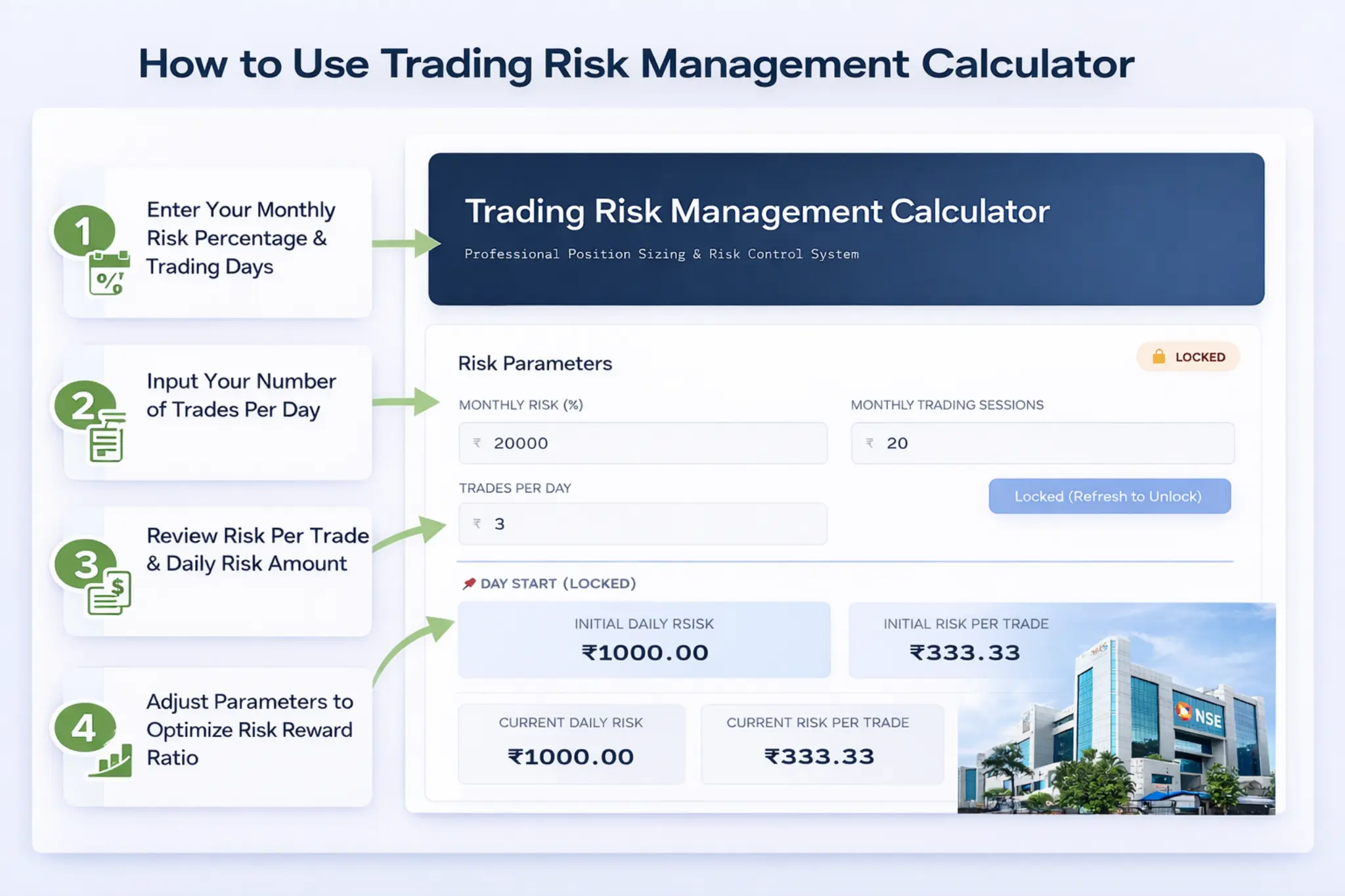
Use a Trading Risk Management Calculator
Manual risk calculation often leads to errors and emotional decisions.
A Trading Risk Management Calculator helps you:
- Calculate position size accurately
- Define risk per trade
- Maintain discipline automatically
- Protect trading capital
👉 Use the Trading Risk Management Calculator here
Final Thoughts: Risk Management Is Non-Negotiable
Risk management in trading is not optional—it is essential.
Whether you trade stocks, forex, crypto, or day trade intraday markets, proper risk management:
- Protects capital
- Reduces stress
- Improves consistency
- Increases long-term profitability
Focus less on predicting markets and more on controlling risk.
Disclaimer: This content is for educational purposes only. Trading involves risk. Always do your own research before trading.