Trading is one of the most common ways to participate in financial markets. Every day, millions of people and institutions buy and sell shares and other financial instruments to get benefit from price movements or manage financial risk.
But what is trading in stock market, and how does it actually work? What do traders buy and sell? Who participates in trading? What are the different types of trading, and how risky is it?
This beginner-friendly guide explains the meaning of stock market trading, how trading works, what can be traded, the major types of trading, how to get started, and the important risks every beginner should understand.
What Is Trading in Stock Market?
Trading in the stock market is the process of buying and selling shares and other financial instruments to take advantage of changes in their market prices. However, trading is also used by some market participants for purposes such as hedging and managing financial risk.
For example, suppose a trader buys a share at ₹100 and later sells it at ₹110.
Profit = ₹10 per share, before brokerage, taxes, and other transaction costs.
However, if the trader buys the share at ₹100 and sells it at ₹90:
Loss = ₹10 per share, before applicable costs.
This simple example shows why trading always involves both opportunity and risk.
The basic idea of trading is simple:
Take a position → The price moves → Exit the position → Profit or loss is determined by the price difference and costs involved.
A trader may hold a position for a few seconds, minutes, hours, days, weeks, or even months, depending on their trading style.
How Trading Work in the Stock Market?
The exact process can vary depending on the market, financial instrument and trading style, but the basic trading process can be understood in a few steps. what is trading in stock market you know but when you know how it works you will be more confident for trading. many people know what is trading in stock market but they not able to do this properly. Now you will be 10 step ahead of them.
1. A Trader Analyses the Market
The process usually begins when a trader identifies a potential trading opportunity.
A trading decision may be based on:
- Technical Analysis
- Price action
- Market trends
- Volume
- Fundamental factors
- News and events
- Economic data
- A predefined trading strategy
For example, a trader may believe that a stock trading at ₹500 has the potential to move higher based on their analysis.
Of course, analysis does not guarantee that the market will move as expected.
2. The Trader Places a Buy or Sell Order
After making a trading decision, the trader places an order through an authorized broker or trading platform.
Common order types include:
- Market orders
- Limit orders
- Stop-loss orders
The exact Types Of Orders available can vary depending on the broker, Exchange, and product.
3. The Order Is Executed
In an exchange-traded market, buy and sell orders are generally matched through the exchange’s trading system according to applicable rules.
Once an order is successfully executed, the trader has entered a position.
4. The Price Changes
After entering a trade, the market can move in either direction.
For example:
Buy at ₹500 → Price rises to ₹520
You get Rs.20 profit before costs.
Buy at ₹500 → Price falls to ₹480
You loss Rs.20 before costs.
The trader cannot control the market’s future movement. They can only control factors such as their position size, risk limits, and exit decisions.
5. The Trader Exits the Position
Eventually, the trader closes the position.
The exit may be based on:
- A profit target
- A stop-loss
- A change in market conditions
- A time-based rule
- Another predefined trading rule
The final result depends on the entry price, exit price, position size, and applicable trading costs.
What Are the Major Types of Trading?
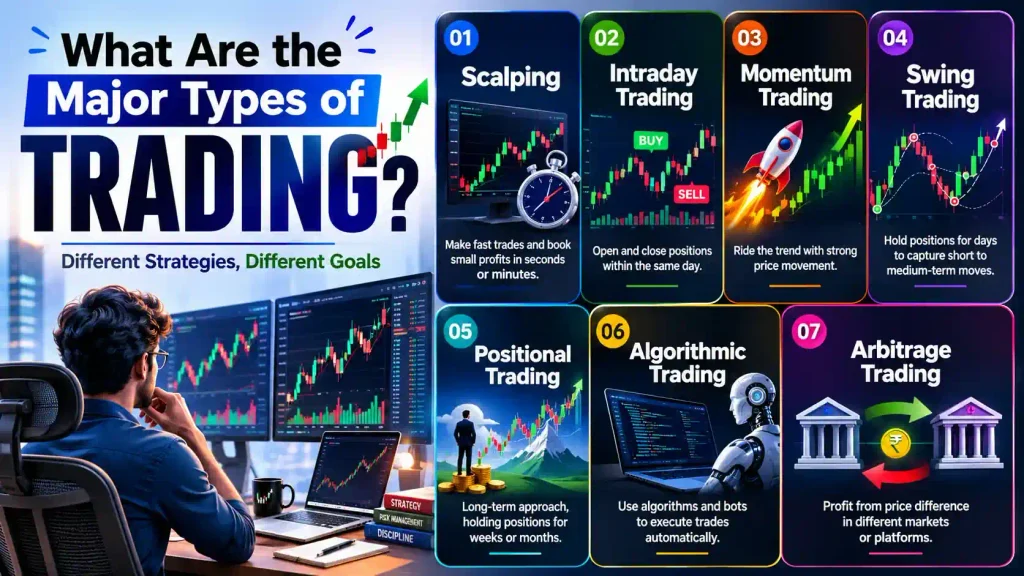
When you knew what is trading in stock market, you hvae to understand types of trading also. Trading styles can differ based on the holding period, strategy, frequency of trades, and market being traded.
Scalping
Scalping is a very short-term trading style in which traders attempt to capture relatively small price movements.
Positions may be held for seconds or minutes.
It generally requires quick decision-making, discipline, and careful attention to transaction costs and liquidity.
Intraday Trading
In intraday trading we buy or short and closing the positions before market closing.
The trader generally attempts to benefit from price movements that occur during market hours.
Momentum Trading
Momentum trading focuses on assets showing strong price movement in a particular direction.
Traders may look for factors such as:
- Strong trends
- Breakouts
- Increased volume
- Relative strength
However, momentum can change quickly, which makes risk management important.
Swing Trading
Swing trading generally involves holding positions for several days or sometimes weeks.
The objective is usually to capture a larger price movement or market swing.
Swing traders may analyse trends, pullbacks, breakouts, and other price patterns.
Positional Trading
Positional trading generally involves holding a position for a longer period, potentially ranging from weeks to months or more.
This approach may involve technical analysis, fundamental factors, and broader market trends.
Algorithmic Trading
Algorithmic trading uses computer programs and predefined rules to identify or execute trades.
Algorithms may use information such as:
- Price
- Volume
- Time
- Technical indicators
- Statistical models
Arbitrage Trading
Arbitrage involves attempting to benefit from price differences between related instruments or markets.
Such opportunities can disappear quickly and may involve execution and transaction-cost risks.
Each trading style has different risks, capital requirements, time commitments, and skill requirements. There is no single trading style that is automatically best for everyone.
How to Start Trading in the Stock Market?
After knowing what is trading in stock market, its time to start trading. Starting trading should involve preparation and learning rather than immediately following tips or placing random trades.
Learn the Basics
Before risking real money, understand:
- How financial markets work
- What you are trading
- How profit and loss are calculated
- How Orders Work
- Trading costs
- Risk Management
- Position sizing
Never trade a financial product that you do not understand.
Choose What You Want to Trade
You do not need to trade every available market.
A beginner can initially focus on learning one area, such as:
- Stocks
- ETFs
- Commodities
- Currency products
- Futures and options
Your choice should depend on your knowledge, interests, capital, available time, and risk tolerance.
Open a Trading Account
Depending on your country and the product you want to trade, you may need the appropriate account with an authorized or registered intermediary. You have to choose right broker according to you need.
In India, participation in exchange-traded securities generally requires the relevant account arrangements and applicable KYC procedures through a SEBI-Registered Broker.
Choose a Trading Style
Choose a style based on factors such as:
- Available time
- Knowledge
- Capital
- Risk tolerance
- Personality
For example, someone who cannot regularly monitor markets during the day may find very short-term trading unsuitable.
Create a Trading Plan
Now you have understood what is trading in stock market, lets create plan for execution in market.
A basic trading plan can define:
- What you will trade
- Why you will enter a trade
- When you will exit
- Where you will limit losses
- How much you will risk
- How large your position will be
A trading plan does not guarantee profits, but it can help reduce impulsive decision-making.
Start Small
A beginner does not need to start with a large amount of capital.
Initially, learning to manage risk, control emotions, and follow a disciplined process can be more important than attempting to generate large profits.
What Should You Expect From Trading?
One of the biggest mistakes beginners make is entering trading with unrealistic expectations. what is trading in stock market now yu understood it but setting realistic expectation is much more importance.
There is no guaranteed monthly or yearly return from trading.
Trading performance can depend on:
- Market conditions
- Trading strategy
- Risk Management
- Transaction costs
- Experience
- Discipline
- Capital
- Drawdowns
A trader may experience profitable periods as well as losing periods.
Instead of only asking:
“How much money can I make every month?”
A more useful question is:
“Can I develop a disciplined process, manage my risk, control losses, and evaluate my performance over time?”
For beginners, the first objective should generally be to understand the market and protect capital while gaining experience.
Trying to quickly double a trading account can encourage excessive risk-taking.
What Can You Trade in the Stock Market?
Trading is not limited to buying and selling company shares. Understanding what is trading in stock market is not enough, you have to understatnd also the what you can trade in the market.
Different financial markets offer different assets and instruments.
Shares or Stocks
Shares are among the most commonly traded financial instruments.
When you buy a company’s share, you acquire an ownership interest in that company.
Bonds and Debt Instruments
Bonds are generally debt instruments used by governments, companies, and other entities to raise money.
Commodities
Commodities include physical resources and raw materials that can be traded directly or through financial instruments.
Examples include:
- Gold, Silver, Crude oil,Natural gas,Copper, Agricultural commodities
Commodity prices can be influenced by global supply and demand, production, weather, geopolitical events, and economic conditions.
Currencies
Currencies are traded against one another in currency and foreign exchange markets.
Examples include:
- EUR/USD, GBP/USD, USD/JPY
Indices
A market index represents the performance of a selected group of securities. Depending on the available market products, traders may gain exposure to an index through instruments such as ETFs, futures, or options.
Examples include:
- Nifty 50, Sensex, S&P 500, Nasdaq-100
Exchange-Traded Funds (ETFs)
ETFs are investment products that can generally be bought and sold on an exchange during market hours.
Example: Gold ETF, Silver ETF, Nifty ETF etc
Derivatives
Derivatives are financial contracts whose value is linked to an underlying asset, index, rate, or other reference. Derivatives may be used for trading or hedging. However, some derivative products can involve leverage and significant risk.
Examples: Futures and Options
Interest Rate Products
In broader financial markets, participants can also trade products linked to interest rates. These products can be more complex and are often used by institutional and professional market participants.
Example: Bonds, Futures, Options, Swaps, Other interest-rate-related instruments
Final Thoughts
So, what is trading in stock market?
Trading in the stock market is the buying and selling of shares and other financial instruments with the aim of benefiting from market price movements or, in some cases, managing financial risk.
A trader can choose from different markets, instruments, and trading styles. These may include stocks, commodities, currencies, ETFs, derivatives, intraday trading, swing trading, positional trading, and other approaches.
However, keep in mind that their is no guarantee in trading to make money. Every opportunity comes with risk.
Before starting, take time to understand how trading works, learn about the product you want to trade, choose a suitable trading approach, manage risk carefully, and maintain realistic expectations.
The goal for a beginner should not be to make quick profits at any cost. The first priority should be learning how markets work, controlling risk, and protecting capital while building knowledge and experience.
Frequently Asked Questions About Trading
What Is Trading in Stock Market in Simple Words?
Trading in the stock market means buying and selling shares and other eligible financial instruments to attempt to benefit from changes in their market prices.
What Is the Main Purpose of Trading?
The main purpose of trading is often to benefit from price movements. However, some market participants also trade to hedge or manage existing financial risks.
Who Can Trade in the Stock Market?
Eligible individuals and institutions that meet applicable legal, regulatory, account, and KYC requirements can participate through appropriate authorized intermediaries.
What Are the Main Types of Trading?
Major trading styles include scalping, intraday trading, momentum trading, swing trading, positional trading, algorithmic trading, and arbitrage trading.
How Much Money Is Required to Start Trading?
There is no universal minimum amount. The capital required depends on the market, product, lot size, margin requirements, strategy, and the amount of risk you can responsibly take.
Is Stock Market Trading Risky?
Yes. Stock market trading involves financial risk, and profits are not guaranteed. Risk can increase significantly because of leverage, excessive position sizes, volatile instruments, and poor risk management.
Can You Make a Regular Income From Trading?
Trading does not guarantee a regular income. Results can vary significantly depending on market conditions, strategy, risk management, costs, and a trader’s skill and discipline.