Investing in an Initial Public Offering (IPO) can be an opportunity to buy shares of a company when it first becomes available to the public. However, investing in an IPO is not simply about applying for shares and expecting a profit. You should understand the What Is IPO?, check the company’s fundamentals, decide how much money you can invest, and then follow the correct application process.
If you are wondering how to invest in IPO, this guide explains the complete IPO investment process in India, including how to apply for an IPO online, how to buy IPO shares, what beginners should know, and whether IPO investment is good or bad.
How to Invest in IPO in India?
To invest in an IPO in India, you generally need a Demat account, a trading account, and a bank account that supports UPI payments. Most investors apply for IPOs online through their Stock broker using the UPI-based application process.
When it comes to buy IPO shares, during the IPO period, you have to apply for shares at the offered price or through the applicable cut-off mechanism. If you receive an allotment, the shares are credited to your Demat account
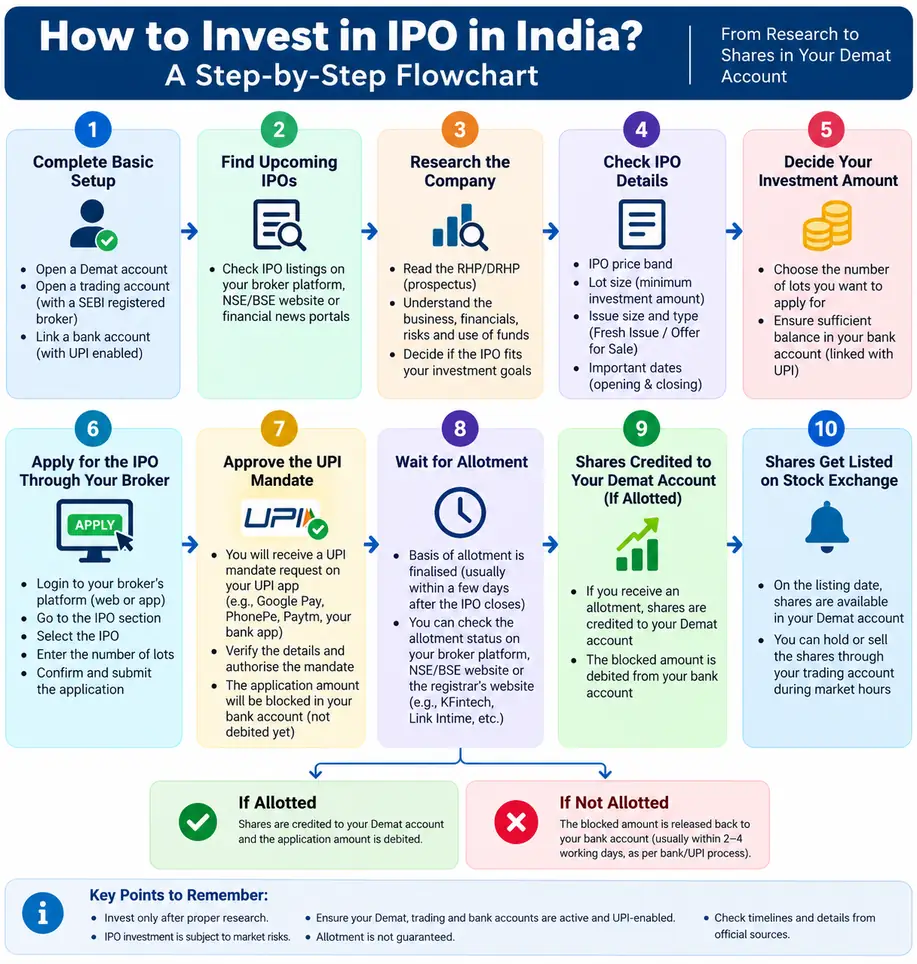
The basic process is:
Select an IPO → Research the company → Check the IPO price and details → Decide your investment amount → Apply through your broker → Approve the UPI mandate → Wait for allotment → Receive shares in your Demat account
If shares are allotted, they are credited to your Demat account. If you do not get IPO shares, the blocked amount is released.
What Do You Need to Invest in an IPO?
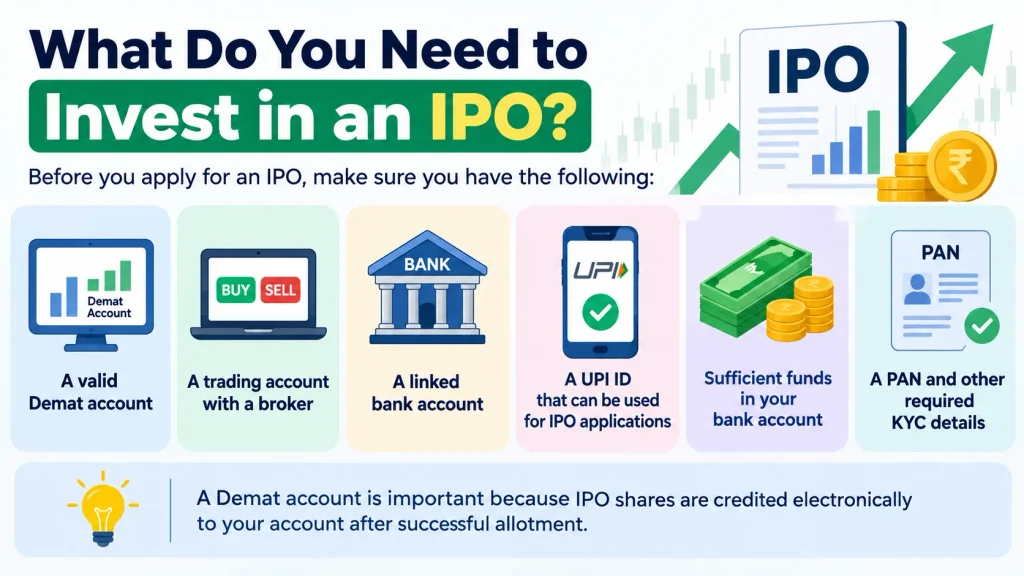
To apply for an IPO for beginners: Before you apply for an IPO, make sure you have the following:
- A valid Demat account
- A trading account with a broker
- A linked bank account
- A UPI ID that can be used for IPO applications
- Sufficient funds in your bank account
- A PAN and other required KYC details
A Demat account is important because IPO shares are credited electronically to your account after successful allotment.
If you want to understand how to invest in an IPO in Hindi, you can change the language from the Menu section.
How to Invest in IPO Online?
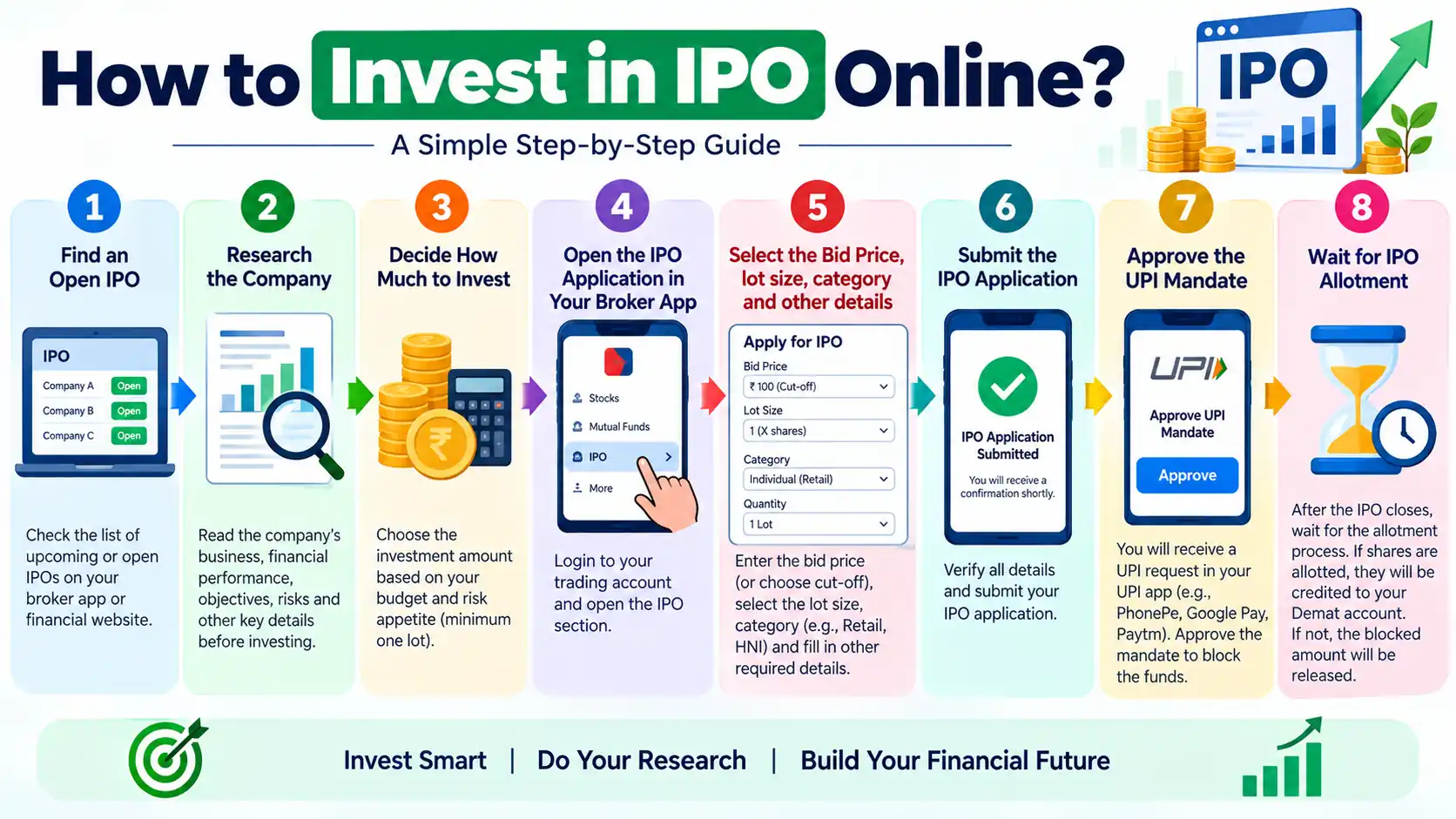
The easiest way for most retail investors is to apply through their broker’s mobile app or website. To know how to invest in IPO stocks, follow the process below step by step.
Step 1: Find an Open IPO
Check which IPOs are currently open for subscription. Your broker will generally show available IPOs under an IPO or investment section.
Before applying, look at important information such as:
- IPO opening and closing dates
- Price band
- Lot size
- Minimum investment
- Issue size
- Fresh issue and offer for sale
- Company’s financial performance
- Use of IPO proceeds
- Risks mentioned in the offer document
Do not choose an IPO solely because it is popular or receiving high subscription numbers.
Step 2: Research the Company
This is one of the most important parts of IPO investing.
Read the company’s offer document and evaluate its business, revenue, profitability, debt, cash flows, competitive position and future plans.
You should also understand why the company is raising money. Funds may be used for purposes such as business expansion, debt repayment, working capital or other corporate requirements.
A strong-looking IPO can still involve substantial investment risk, so research should come before the application.
Step 3: Decide How Much to Invest
After researching the IPO, decide whether it fits your investment goals and risk tolerance.
For beginners, it is generally better to avoid putting a large portion of available capital into a single IPO just because you expect listing gains.
Remember that IPO investment does not guarantee a profit.
Step 4: Open the IPO Application in Your Broker App
Log in to your broker’s app and select the IPO you want to apply for.
You will normally need to enter details such as:
- Number of lots
- Bid price
- Investor category
- UPI ID
For a retail application, you should stay within the applicable retail investment limit and other rules.
Step 5: Select the Bid Price
An IPO usually has a price band with a minimum and maximum price.
For a retail investor, the Cut-Off option can be useful when available. By selecting cut-off, you agree to purchase at the final issue price determined through the IPO process, rather than entering a specific price within the band.
Step 6: Submit the IPO Application
After entering the required details, submit the application through your broker.
Your application itself does not mean that you have purchased the shares. The amount required for the application is generally blocked in your bank account through the UPI mandate process.
Step 7: Approve the UPI Mandate
After submitting the application, you need to approve the IPO-related UPI mandate in your UPI app.
Make sure the details are correct before approving it and keep sufficient funds available in your bank account.
The money is generally blocked rather than immediately debited for the application. The final amount used depends on the shares allotted and the applicable IPO process.
Step 8: Wait for IPO Allotment
Once the subscription period ends, the allotment process takes place.
There are generally three possible outcomes:
Shares allotted: The required amount is debited, and the allotted shares are credited to your Demat account.
No shares allotted: The blocked amount is released.
Partial allotment: You receive fewer shares than you applied for, and the remaining applicable amount is released.
After allotment, you can check the shares in your Demat account.
The important point is that IPO investing should begin with research, not with the expectation of quick returns.
Before listing: Apply for the IPO → Wait for allotment.
After listing: Buy shares through your trading account at the prevailing market price.
Is IPO Investment Good or Bad?
IPO investment is neither automatically good nor bad. It depends on the company, IPO valuation, business prospects and your investment objectives. You know how to invest in IPO but is it good or bad not know. Do you know electric current is good or bad?
An IPO may provide an opportunity to invest in a growing company, but it can also carry risks. The stock price may fall after listing if market expectations are not met.
Before investing, consider:
- Company fundamentals
- Revenue and profit trends
- Debt levels
- Valuation
- Industry outlook
- Promoter background
- Competitive advantages
- Risks mentioned in the offer document
- How the IPO proceeds will be used
A good company can still be a poor investment if its IPO valuation is too high.
Is It Safe to Invest in an IPO?
IPO investing carries market risk, so it should not be considered completely safe. You know how to invest in IPO but is it safe or not, you not know but you can find is it safe or not by knowing when you get answer of this questuion- Is swimming is safe?
The company is entering the public market, and its share price can move significantly after listing. You may receive an allotment and still incur a loss if the market price falls below your purchase price.
Therefore, do not invest in an IPO only because it is oversubscribed or receiving significant attention. Subscription data shows demand for the issue, but it does not guarantee future returns.
Is IPO Investment Good for Beginners?
Beginners can invest in IPOs, but they should first understand what is the purpose of an IPO and the risks involved in the business.
If you are new to investing, avoid making an IPO application purely because you expect listing gains. Instead, learn how to evaluate a company and understand whether its valuation makes sense for your investment period.
As a beginner, you should focus on risk management, diversification and long-term investment decisions rather than trying to predict short-term listing performance.
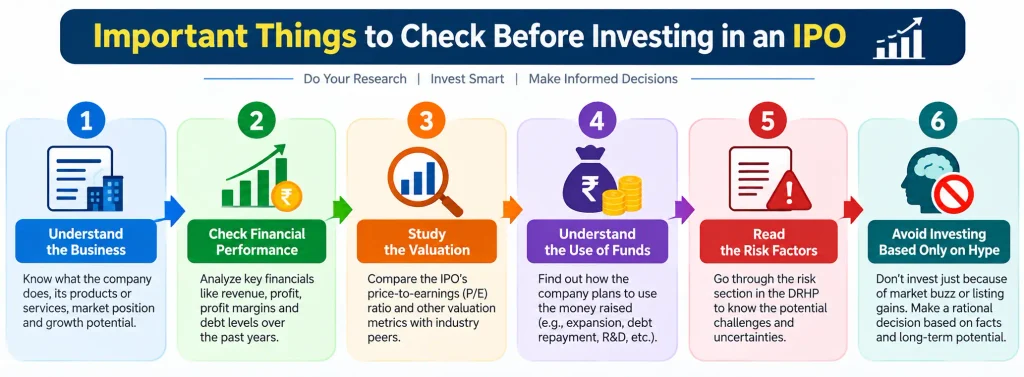
Important Things to Check Before Investing in an IPO
Now that you have understood how to invest in IPO, check these important things before applying for an IPO.
1. Understand the Business
Know what the company actually does, how it earns money and what makes its business competitive.
2. Check Financial Performance
Look at revenue, profit, margins, debt and cash flows over multiple years rather than focusing on one financial year.
3. Study the Valuation
Compare the IPO valuation with comparable listed companies in the same industry. A high-quality business may still be expensive at the offered price.
4. Understand the Use of Funds
Find out whether the money is being raised for expansion, debt repayment, working capital or other purposes.
5. Read the Risk Factors
The IPO offer document contains important risks associated with the company and its business. Do not ignore this section.
6. Avoid Investing Based Only on Hype
News, social media discussions and high subscription figures can create excitement around an IPO. They should not replace fundamental research.
IPO Investment: Common Mistakes Beginners Should Avoid
Everyone should know how to invest in IPO, but new investors often make mistakes because they focus more on listing gains than the risk involved in these IPO shares.
Some common mistakes include:
- Applying without researching the company
- Investing money needed for short-term expenses
- Assuming every IPO will give listing gains
- Applying only because an IPO is heavily subscribed
- Ignoring the company’s valuation
- Putting too much money into one IPO
- Following social media recommendations blindly
- Ignoring the risk factors in the offer document
A disciplined approach can help you make more informed IPO investment decisions.
Final Thoughts on How to Invest in IPO
Learning how to invest in IPO is relatively straightforward, but deciding which IPO to invest in requires much more attention.
You can apply online through a broker using the UPI-based process, but the real investment decision starts before you submit the application. Research the company, understand its financial position, evaluate the IPO valuation, assess the risks and invest only an amount that matches your financial situation and risk tolerance.
For beginners, the goal should not simply be to get IPO allotment or make quick listing gains. The better approach is to understand the business and make an investment decision based on research rather than hype.