Skip to content
Wednesday, November 18, 2026
History of Derivatives Market and Evolution (World & India) | Complete Timeline with Memory Tricks
IPO Allotment Status – Check IPO Allotment Online
How to Invest in IPO in India: A Beginner’s Guide to Applying for an IPO
What Is IPO? Meaning, Full Form, How It Works, Benefits, Risks & Example

Civil Shares

Stock Market Trading and Investment Education

  • Home
  • Indices
  • India Vix
  • Nifty Index
    • Nifty 50
    • Nifty Next 50
    • Nifty Smallcap 50
    • Nifty 500
    • Nifty All Shares
  • Learn
    • What is Share Market?
    • Why invest in stocks?
    • How to Invest in stocks?
    • How to choose right broker?
    • How to select stocks?
    • Who are market participants?
    • How to place order?
    • What is Trading?
    • What is technical analysis?
    • Risk management in trading
    • Risk management calculator
    • How to use risk management calculator?
  • IPO
    • What is IPO?
    • How to invest in IPO?
    • Check allotment status
    • IPO Process (Idea to Listing)
  • Risk Management

Home » India Vix

India Vix

India Vix calculation and nifty range calculator
  • India Vix

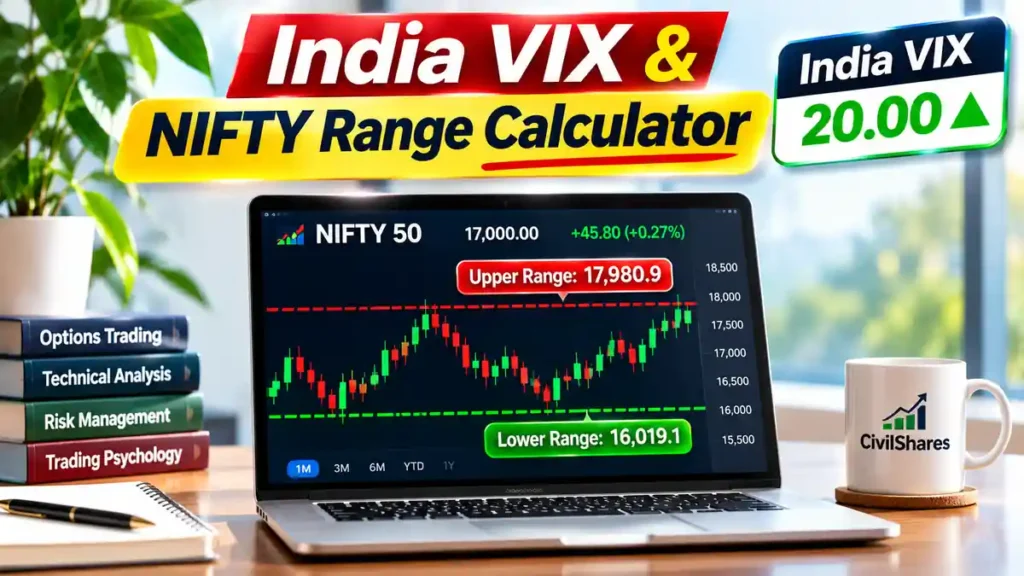
India VIX Calculation: Formula & NIFTY Range Calculator

Civil SharesDecember 23, 2024December 20, 2024011 mins

India VIX is one of the most useful volatility indicators for traders and investors who follow the NIFTY 50 index. It helps market participants understand how much volatility the options market is expecting over the next 30 calendar days. But simply knowing the India VIX value is not enough. The real advantage comes from understanding…

Read Full News

Categories

  • Calculators
    • Age Calculator
    • Annualized Return Calculator
    • Averaging Calculator
    • CAGR Calculator
    • DCF Calculator
    • EMI Calculator
    • Intrinsic Value Calculator
    • Lumpsum Calculator
    • Present Value Calculator
    • PV & FV Calculator
    • Risk Management Calculator
    • SIP and Lumpsum Calculator
    • SIP Calculator
  • India Vix
  • Indices
  • IPO
  • Learn
  • Quarterly Result
  • Stock Market Holidays

Search

  • History of Derivatives Market and Evolution (World & India) | Complete Timeline with Memory Tricks
  • IPO Allotment Status – Check IPO Allotment Online
  • How to Invest in IPO in India: A Beginner’s Guide to Applying for an IPO
  • What Is IPO? Meaning, Full Form, How It Works, Benefits, Risks & Example
  • What Is Trading in Stock Market? Meaning, Types, How It Works and How to start

“I believe in analysis and not forecasting.” - Nicolas Darvas

“An investment in knowledge pays the best interest.” -Benjamin Franklin

“All you need is one pattern to make a living.” - Linda Raschke

"Buy when others are fearful; sell when others are greedy." - Warren Buffett

Quick Links

About Contact Us Disclaimer Privacy Policy Sitemap

Disclaimer:
The content provided on CivilShares.com is for educational and informational purposes only. We do not provide investment, financial, or trading advice, and nothing on this website should be interpreted as a recommendation to buy, sell, or hold any financial instruments. The information shared is based on personal research, market knowledge, and publicly available sources. It is not intended to be a substitute for professional advice. Visitors are advised to consult with a SEBI-registered financial advisor before making any investment decisions. CivilShares.com, its owner, and contributors are not responsible for any losses arising from the use of content published on this site. Trading and investing involve risk, and past performance is not indicative of future results. This website is independently managed and has no direct affiliation with any brokerage or financial firm.

© 2026 CivilShares. All Rights Reserved.

Table of Contents

×
  • NIFTY Range Calculator
    • 1 Enter market values
    • 2 Select calculation period
    • Estimated NIFTY range
    • What Is India VIX?
    • How Is India VIX Calculated?
      • 1. Selection of NIFTY Options
      • 2. Calculation of the Midpoint of Bid and Ask Prices
      • 3. Calculation of Time to Expiry (T)
      • 4. Risk-Free Interest Rate (R)
      • 5. Calculation of the Forward Index Level (F)
      • 6. Calculation of Option-Based Variance
      • 7. Combining Near-Month and Next-Month Expiry Variance
      • 8. Annualization and Final India VIX Value
    • What Is the India VIX Formula for Calculating NIFTY Range?
      • Why Is the Square Root of 12 Used in India VIX Calculation?
      • How to Calculate NIFTY Range Using VIX?
    • NIFTY Range Calculator Using VIX: Daily, Weekly and Monthly Formula
    • India VIX Calculation Excel: How to Calculate NIFTY Range?
      • Step 1: Enter the Input Values
      • Step 2: Apply Excel Formulas
      • Step 3: Understand the Output
    • How to Read India VIX?
      • 1. Low India VIX
      • 2. High India VIX
      • 3. Rising India VIX
      • 4. Falling India VIX
    • How Reliable Are India VIX-Based NIFTY Range Predictions?
      • 1. It Is Based on Expected Volatility
      • 2. Sudden Market Events
      • 3. Volatility Is Not Constant
      • 4. The Range Does Not Predict Market Direction
      • 5. Use It Alongside Other Trading Tools
    • Conclusion
→ Index