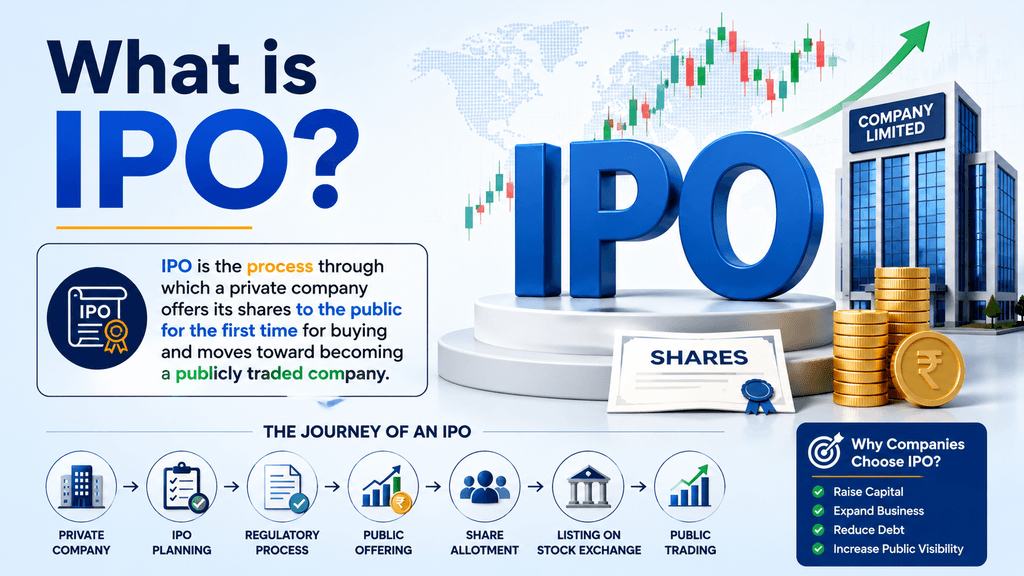
IPO stands for Initial Public Offering, and when you ask what is IPO, it is the process through which a privately held company offers its shares to the public for the first time and becomes a publicly listed company.
It allows a company to raise money from public investors by selling shares, while investors get an opportunity to become shareholders of the company.
But how does an IPO work? Why do companies issue IPOs? Who can invest in an IPO? How is the IPO share price decided? And can investors actually make money from an IPO?
Let’s understand everything step by step.
What is IPO in the stock market?
An IPO (Initial Public Offering) is the process by which a private company offers its shares to the public for the first time.
Before an IPO, the company’s ownership is generally held by founders, promoters, private investors, venture capitalists, or other existing shareholders. After completing the IPO process and getting listed on a stock exchange, the company’s shares can be traded publicly.
In the stock market, an IPO represents a company’s entry into the public market.
For example, suppose a private company named ABC Ltd. wants to expand its business but needs ₹500 crore in capital. Instead of borrowing the entire amount from banks, it may decide to raise money by offering a portion of its shares to the public.
Once the IPO is completed and the shares are listed on a stock exchange, investors can buy and sell those shares in the secondary market.
So, the basic flow is:
Private Company → IPO → Public Company → Stock Exchange → Public Trading
How Does an IPO Work?
The IPO process involves several stages. A company cannot simply decide one day to sell its shares to the public. It has to go through regulatory, financial and procedural requirements before the shares can be listed.
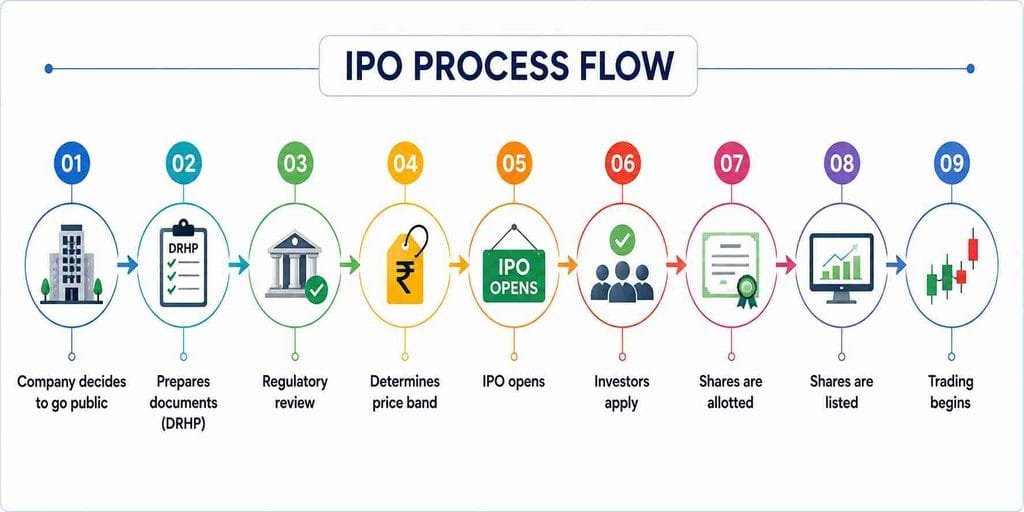
A simplified IPO process looks like this:
Company decides to go public → Prepares documents (DRHP) → Regulatory review→ Determines price band → IPO opens → Investors apply → Shares are allotted → Shares are listed → Trading begins
For Complete IPO Process you can also read: How a Company Goes Public from Idea to Stock Market Listing.
Let’s understand these stages.
1. Company decides to go public
A private company first decides that it wants to raise capital from public investors and become publicly listed.
2. Preparation of IPO documents (DRHP)
The company prepares detailed documents called Draft Red Herring Prospectus (DRHP), containing information about its business, financial performance, management, risks and proposed use of the funds.
3. Regulatory review
The proposed IPO goes through the applicable regulatory process. In India, SEBI (Securities and Exchange Board of India) plays an important role in regulating the securities market and IPO framework.
4. Price band is determined
For a book-built IPO, the company and its advisors announce a price band within which investors can submit their bids.
For example:
Price band: ₹95–₹100 per share
An investor may place a bid within the specified price range according to the issue rules.
5. IPO opens for subscription
The IPO is opened for investors for a specified period. Investors submit applications for the number of shares or lots they want to purchase.
6. Shares are allotted
After the subscription period closes, shares are allotted according to the applicable allocation rules.
If an IPO receives significantly more applications than the number of shares available, some applicants may not receive any shares.
7. Shares are listed
After allotment and completion of the necessary procedures, the company’s shares are listed on a stock exchange.
From this point, investors can generally buy and sell the shares in the secondary market.
Why Do Companies Issue an IPO?
One of the biggest reasons companies issue IPOs is to raise capital.
However, raising money is not the only reason. Companies may use an IPO for several purposes.
1. To raise capital for business expansion
A company may need funds to:
- Build new facilities
- Enter new markets
- Expand production
- Develop new products
- Acquire other businesses
- Invest in technology
An IPO can provide access to a larger pool of investors.
2. To repay or reduce debt
Some companies may use part of the funds raised through an IPO to repay certain borrowings or strengthen their balance sheet, depending on the stated objectives of the issue.
3. To fund future growth
A growing business may require substantial capital for future projects. Going public can provide another source of financing.
4. To provide an opportunity for existing shareholders
In some IPOs, existing shareholders may offer some of their shares to the public through an Offer for Sale (OFS).
In such a case, the money associated with those shares generally goes to the selling shareholders rather than being raised by the company itself.
5. To create a public market for the company’s shares
Once listed, the company’s shares can be publicly traded, providing liquidity to shareholders.
What Is the Difference Between IPO Price and Listing Price?
These two terms are often confused.
IPO Price
The IPO price is the price at which shares are offered to successful investors through the IPO.
Listing Price
The listing price is the price at which the shares begin trading on the stock exchange.
For example, suppose:
- IPO price = ₹100
- Listing price = ₹120
An investor who received the shares at ₹100 would see a ₹20 difference per share at the time of listing, before considering applicable costs and taxes.
However, the listing price can also be lower than the IPO price.
Therefore, an IPO does not guarantee a listing gain.
What Are the Benefits of Investing in an IPO?
Investing in an IPO can provide certain opportunities, although returns are never guaranteed.
Potential benefits include:
1. Opportunity to invest in a growing company
An IPO may provide investors with an opportunity to invest in a company at the beginning of its public-market journey.
2. Potential listing gains
If demand is strong and the market values the company above its issue price, the shares may list at a higher price.
3. Long-term growth opportunity
If the company’s business grows successfully, shareholders may benefit from long-term appreciation.
4. Portfolio diversification
Depending on an investor’s strategy, IPOs can provide access to companies and industries that may not have been part of their portfolio previously.
But these are potential benefits, not guaranteed returns.
What Are the Risks of Investing in an IPO?
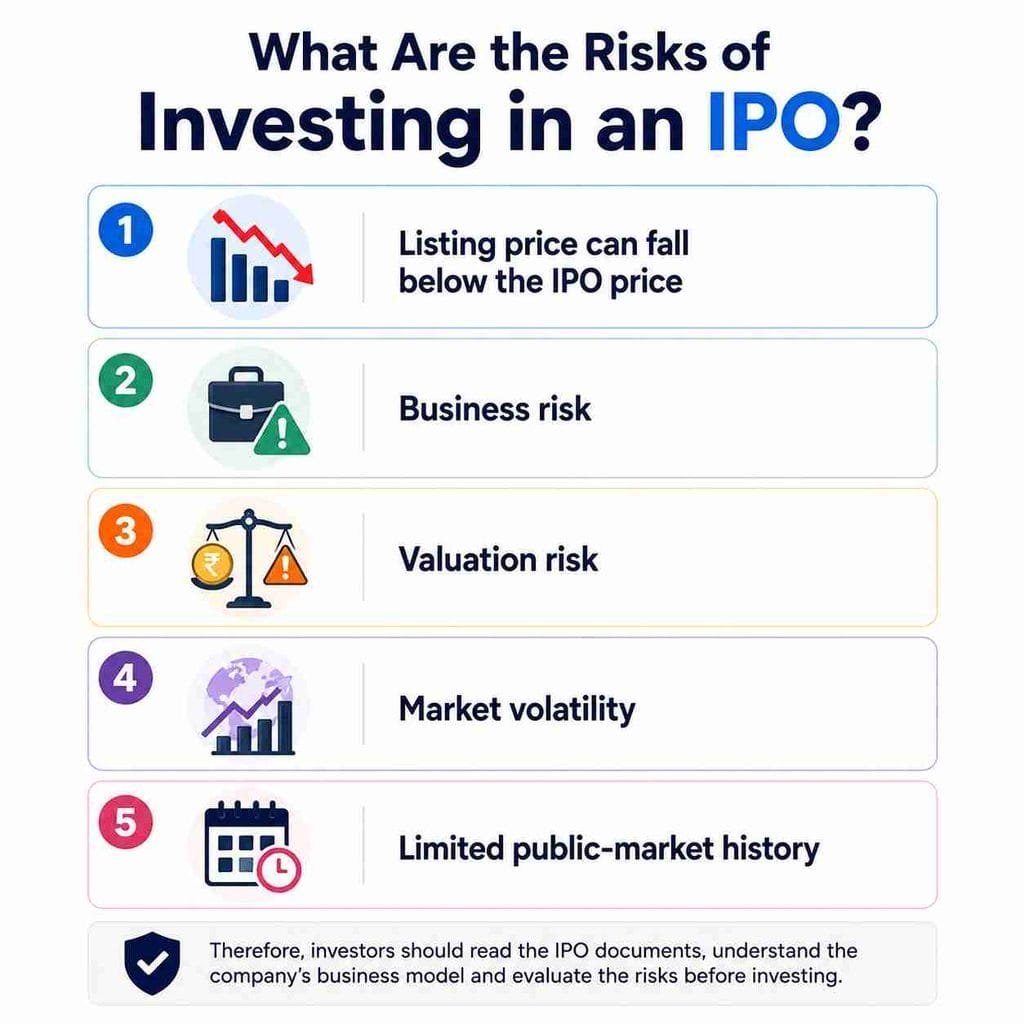
Understanding the risks is just as important as understanding the benefits.
1. Listing price can fall below the IPO price
A company can list below its issue price if market demand or investor sentiment is weaker than expected.
2. Business risk
The company may not achieve its projected growth or business objectives.
3. Valuation risk
A company can be fundamentally good but still be offered at a valuation that investors consider expensive.
4. Market volatility
Stock prices can change because of economic conditions, interest rates, industry developments, market sentiment and company-specific events.
5. Limited public-market history
A newly listed company may have less publicly traded market history than an established listed company.
Therefore, investors should read the IPO documents, understand the company’s business model and evaluate the risks before investing.
What Is an IPO Example?
Let’s understand an IPO with a simple hypothetical example.
Suppose ABC Technologies Ltd. is a private company that wants to raise ₹200 crore. It decides to offer 2 crore shares to the public at an issue price of ₹100 per share. If the entire issue is successfully subscribed:
2 crore shares × ₹100 = ₹200 crore
The company can use the funds for the purposes disclosed in its IPO documents. After the IPO process is completed, the shares are listed on a stock exchange.
Now suppose the shares begin trading at ₹120. If you get 100 shares at ₹100 at total rupees of ₹10,000, now has its market value of ₹12,000 at ₹120, compared with IPO price. But if the share is trading at ₹80, the same investment would be worth ₹8,000.
This illustrates an important point:
An IPO can create an opportunity for profit, but it can also result in a loss.
Things to Check Before Investing in an IPO
Before applying for an IPO, investors should look beyond the popularity of the issue.
| Factor | What Should You Check? | Why Is It Important? |
|---|---|---|
| Company’s Financial Performance | Revenue, profits, profit margins, cash flows and debt | Helps you understand the company’s financial health and stability. |
| Business Model | How the company makes money and whether its business has sustainable growth potential | Helps determine whether the company’s business can remain profitable and grow over time. |
| Use of IPO Proceeds | Why the company is raising money and how it plans to use the funds | Shows whether the IPO funds will be used for expansion, debt repayment, working capital or other stated purposes. |
| Valuation | Compare the company’s valuation with similar listed companies and its financial performance | Helps determine whether the IPO appears reasonably valued compared with its peers. |
| Risks | Risk factors and important disclosures mentioned in the IPO documents | Helps you understand the potential challenges and downside risks before investing. |
| Promoters & Management | Track record, experience and governance history of promoters and management | Strong and experienced management can be an important factor when evaluating a company. |
| Market Conditions | Overall market sentiment, investor demand and current market environment | Market conditions can influence IPO demand, listing performance and post-listing share prices. |
Final Takeaway
An IPO, or Initial Public Offering, is an important process through which a private company enters the public stock market by offering shares to public investors.
For a company, an IPO can provide access to capital for growth and other stated objectives. For investors, it can provide an opportunity to participate in a company’s growth. However, an IPO is not a guaranteed way to make money.
Before investing, investors should understand the company’s business, financial performance, valuation, purpose of the issue and associated risks rather than making a decision based only on market hype or subscription numbers.
Frequently Asked Questions About IPO
What does IPO stand for?
IPO stands for Initial Public Offering. It is the process through which a private company offers its shares to the public for the first time.
What is IPO in the stock market?
An IPO is a company’s first public offering of shares, allowing it to raise capital from public investors and eventually become listed for public trading.
Can anyone invest in an IPO?
Not necessarily. Eligibility, investor category, investment limits and other requirements depend on the specific IPO and applicable regulations.
Does an IPO always give profit?
No. An IPO does not guarantee profit. The shares may list above or below the issue price, and their value can rise or fall after listing.
Is IPO investment safe?
IPO investment carries market and company-specific risks. Investors should understand the business, valuation and risks before investing.
What is DRHP in IPO?
DRHP (Draft Red Herring Prospectus) is a preliminary document containing key information about a company and its proposed IPO. It is submitted to SEBI for review before the IPO launch.