The derivatives market has evolved over several centuries, from simple agreements for the future delivery of commodities to complex financial contracts traded on modern stock exchanges.
Understanding the history of derivatives market is important because it helps us understand how futures, options, and other derivative products developed over time. And also this will increase your confidence in this product because when you know when it was started and what is its positioning in the market then you can know the future of this product.
Let’s understand everything in a simple and easy-to-remember way.
1. History of Derivatives Market Worldwide
Initially, derivatives-like contracts were used mainly by traders and producers to manage uncertainty regarding future prices and delivery of commodities. Over the time, these contracts evolved into standardized financial instruments traded on organized exchanges.
Let’s understand the important milestones chronologically.
A. Early History of the Derivatives Market
12th Century – European Trade Fairs
- During European trade fairs, sellers signed contracts promising the future delivery of the items they sold.
- These agreements allowed buyers and sellers to arrange transactions in advance.
Key Concept: Future Delivery
13th Century – English Cistercian Monasteries
- English Cistercian monasteries frequently sold their wool to foreign merchants.
- In some cases, wool was sold up to 20 years in advance.
Key Concept: Wool + Advance Sale
1634–1637 – Tulip Mania in Holland
- During this period, speculative trading in tulip futures became extremely popular in Holland.
- The speculative boom eventually collapsed, resulting in heavy financial losses.
Key Concept: Tulip Bubble Burst
Late 17th Century – Dojima Rice Futures Market, Japan
- A futures market in rice was developed at Dojima, near Osaka, Japan.
- The main objective was to protect rice producers from risks associated with bad weather and warfare.
Key Concept: Rice + Protection
B. Development of the Modern Derivatives Market
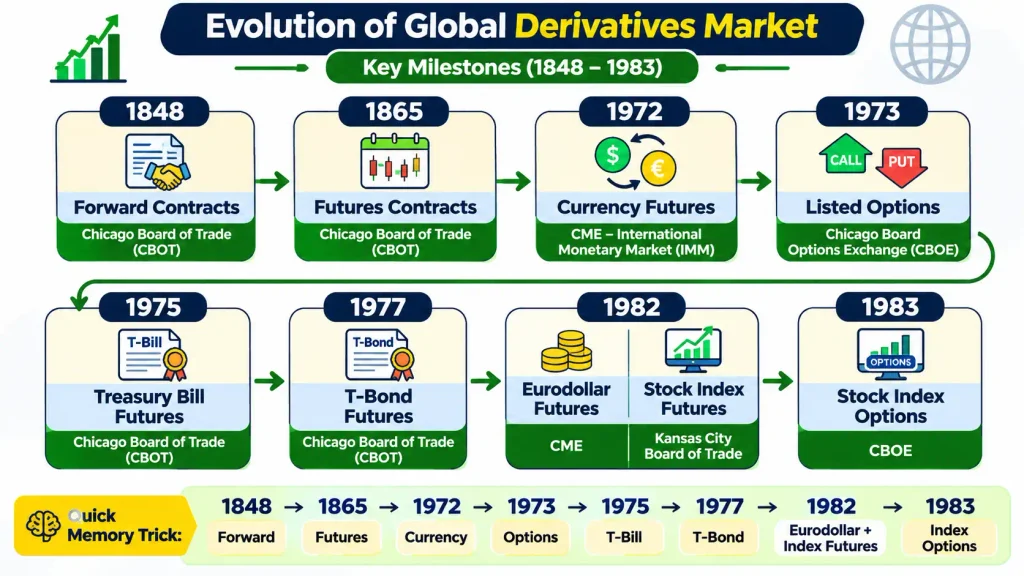
The development of organized derivatives exchanges brought standardization and transparency to derivatives trading.
Here are the most important milestones:
| Year | Important Development | Key Concept |
|---|---|---|
| 1848 | Chicago Board of Trade (CBOT) facilitated trading of forward contracts on various commodities. | Forward Contracts |
| 1865 | CBOT listed the first exchange-traded derivative contract in the US, known as futures contracts. | Futures Contracts |
| 1919 | Chicago Butter and Egg Board was reorganized to allow futures trading. Later, its name was changed to Chicago Mercantile Exchange (CME). | CME |
| 1972 | CME introduced the International Monetary Market (IMM), allowing trading in currency futures. | Currency Futures |
| 1973 | Chicago Board Options Exchange (CBOE) became the first marketplace for trading listed options. | Options |
| 1975 | CBOT introduced Treasury Bill futures contracts, the first successful pure interest rate futures. | T-Bill Futures |
| 1977 | CBOT introduced T-Bond futures contracts. | T-Bond Futures |
| 1982 | CME introduced Eurodollar futures contracts. | Eurodollar Futures |
| 1982 | Kansas City Board of Trade launched the first stock index futures. | Index Futures |
| 1983 | CBOE introduced options on stock indices, including S&P 100 (OEX) and S&P 500 (SPX). | Index Options |
Easy Memory Trick: Important Years in the Global Derivatives Market
Instead of memorizing every historical event separately, remember these important years and their keywords:
- 1848 → Forward Contracts
- 1865 → Futures Contracts
- 1972 → Currency Futures
- 1973 → Listed Options
- 1975 → Treasury Bill Futures
- 1977 → T-Bond Futures
- 1982 → Eurodollar Futures + Stock Index Futures
- 1983 → Stock Index Options
Special Memory Trick: Remember the sequence
1972 → 1973 → 1975 → 1977
Currency → Options → T-Bill → T-Bond
These years follow a chronological sequence, making them easier to remember during examinations.
2. Factors Influencing the Growth of the Derivatives Market
Over the time, the derivatives market has grown intendively worldwide. The NSE is the world’s largest derivatives exchange in the world by the number of contracts traded. Many new derivative contracts have been introduced on exchanges across different countries. But what are the major reasons behind this growth?
There are five important factors.
1. Increased Price Fluctuations
- Prices of underlying assets fluctuate frequently in financial markets.
- These fluctuations create uncertainty for investors and traders.
- Derivatives product like futures and options help to manage price-related risks.
2. Global Integration of Financial Markets
- Financial markets across different countries are interconnected.
- Global economic developments can influence financial markets worldwide.
- Every exachanges are connected and getting each and every information easily.
3. Use of Latest Technology
- Improvements in communication and trading technology have made transactions faster and more efficient.
- Modern technology has helped reduce transaction costs and fast order execution.
- It has also made derivatives trading more accessible.
4. Better Understanding of Risk Management Tools
- Market participants have developed a better understanding of complex risk management tools.
- Derivatives such as futures and options help market participants manage different types of financial risks.
5. Frequent Innovations
- New derivative products and applications are continuously developing according to changing consumer behaviour.
- Financial institutions and exchanges introduce innovative products to meet changing market requirements.
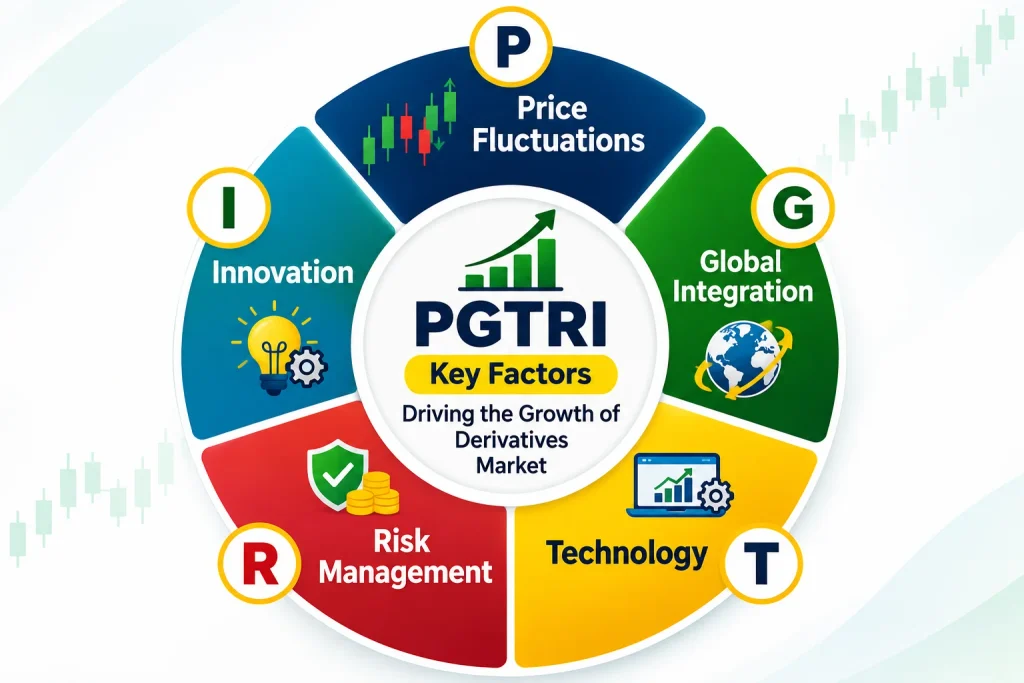
Easy Memory Trick: Five Factors Behind Derivatives Market Growth
Remember the abbreviation:
P – G – T – R – I
| Letter | Factor |
|---|---|
| P | Price Fluctuations |
| G | Global Integration |
| T | Technology |
| R | Risk Management |
| I | Innovation |
Simply remember:
Price → Global → Technology → Risk → Innovation
These are the five major factors influencing the growth of the derivatives market worldwide.
You can aslo read: Risk Management in Trading: Complete Guide for Beginners to Professionals
3. History and Evolution of the Indian Derivatives Market
The Indian derivatives market developed through several regulatory changes and important committee recommendations. SEBI played a major role in establishing the regulatory framework for derivatives trading in India.
Let’s understand the complete timeline step by step.
1996 – L. C. Gupta Committee
- On November 18, 1996, SEBI established a 24-member committee under the chairmanship of Dr. L. C. Gupta.
- The main objective was to develop an appropriate regulatory framework for derivatives trading in India.
- The committee submitted its report on March 17, 1998.
- It recommended that derivatives should be declared as securities so that the existing regulatory framework applicable to securities could also govern derivatives trading.
Key Concept: L. C. Gupta = Regulatory Framework
1998 – J. R. Varma Committee
- In June 1998, SEBI established another committee under the chairmanship of Prof. J. R. Varma.
- Its main objective was to recommend measures for risk containment in the Indian derivatives market.
- The committee submitted its report in October 1998.
The committee worked on several important operational requirements, including:
- Margining system.
- Methodology for charging initial margins.
- Membership details.
- Net-worth criteria.
- Deposit requirements.
- Real-time monitoring of positions.
Key Concept: J. R. Varma = Risk Containment (Risk Management)
1999 – Securities Contracts (Regulation) Act (SCRA) Amendment
- In 1999, the Securities Contracts (Regulation) Act (SCRA) was amended.
- The amendment included derivatives within the definition of securities.
- This helped establish the regulatory framework for governing derivatives trading in India.
Key Concept: SCRA = Derivatives Included as Securities
March 2000 – Removal of Forward Trading Restriction
- In March 2000, the government repealed a three-decade-old notification.
- This notification had prohibited forward trading in securities.
Key Concept: Removal of Forward Trading Restriction
June 2000 – Introduction of Equity Derivatives in India
This was one of the most important milestones in the history of the Indian derivatives market.
- SEBI permitted BSE and NSE to introduce the equity derivatives segment.
- Initially, SEBI approved index futures contracts based on Nifty and Sensex.
- Trading in these index futures contracts commenced in June 2000.
Key Concept: Index Futures = June 2000
June 2001 – Introduction of Index Options
- Trading in index options commenced in June 2001.
Key Concept: Index Options = June 2001
July 2001 – Introduction of Individual Stock Options
- Trading in options on individual stocks commenced in July 2001.
Key Concept: Stock Options = July 2001
November 2001 – Introduction of Individual Stock Futures
- Futures contracts on individual stocks started trading in November 2001.
Key Concept: Stock Futures = November 2001
February 2013 – MSEI Started Derivatives Trading
- Metropolitan Stock Exchange of India Limited (MSEI) started trading in derivative products in February 2013.
Key Concept: MSEI = February 2013
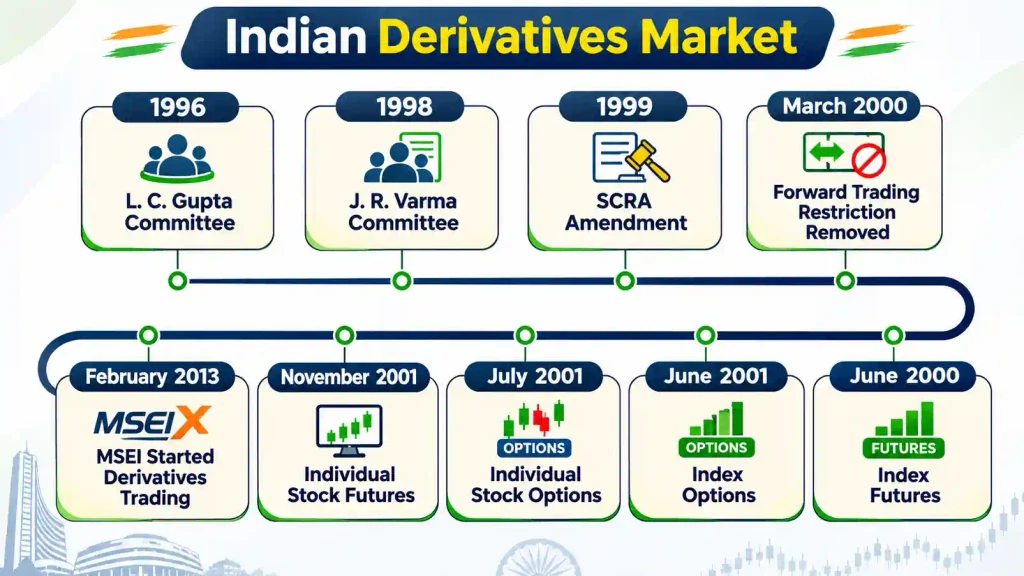
4. Indian Derivatives Market – Complete Timeline for Quick Revision
Let’s summarize all the important events in one table.
| Year | Important Event | What to Remember |
|---|---|---|
| 1996 | L. C. Gupta Committee established | Regulatory Framework |
| 1998 | J. R. Varma Committee established | Risk Containment |
| 1999 | SCRA amended | Derivatives included as securities |
| March 2000 | Forward trading restriction removed | Forward Trading |
| June 2000 | Index futures introduced | Nifty and Sensex Futures |
| June 2001 | Index options introduced | Index Options |
| July 2001 | Individual stock options introduced | Stock Options |
| November 2001 | Individual stock futures introduced | Stock Futures |
| February 2013 | MSEI started derivatives trading | MSEI |
Easy Memory Trick: Indian Derivatives Market
First, remember the committee sequence:
1996 → 1998 → 1999
- 1996 = L. C. Gupta Committee
- 1998 = J. R. Varma Committee
- 1999 = SCRA Amendment
Next, remember the introduction of derivatives:
2000 → 2001
- June 2000 = Index Futures
- June 2001 = Index Options
- July 2001 = Individual Stock Options
- November 2001 = Individual Stock Futures
Finally:
2013 = MSEI
One Important Concept to Remember
The development of equity derivatives in India followed this sequence:
- First, Index Futures were introduced.
- Then, Index Options were introduced.
- After that, Individual Stock Options were introduced.
- Finally, Individual Stock Futures were introduced.
Remember the sequence:
Index Futures → Index Options → Stock Options → Stock Futures
This sequence is particularly important for NISM examination preparation.
5. Quick Revision – Important Facts to Remember
Before moving to the practice questions, let’s revise the most important facts.
Global Derivatives Market
- 12th Century – Future delivery contracts in European trade fairs.
- 13th Century – English monasteries sold wool in advance.
- 1634–1637 – Tulip Mania in Holland.
- Late 17th Century – Dojima rice futures market in Japan.
- 1848 – CBOT facilitated forward contract trading.
- 1865 – First exchange-traded futures contract in the US.
- 1972 – Currency futures at IMM.
- 1973 – CBOE became the first marketplace for listed options.
- 1982 – Eurodollar futures and first stock index futures.
- 1983 – Options on stock indices.
Factors Influencing Derivatives Market Growth
Remember five factors:
- Increased price fluctuations.
- Global integration of financial markets.
- Use of latest technology.
- Better understanding of risk management tools.
- Frequent innovations.
Indian Derivatives Market
- 1996 – L. C. Gupta Committee.
- 1998 – J. R. Varma Committee.
- 1999 – SCRA Amendment.
- March 2000 – Forward trading restriction removed.
- June 2000 – Index Futures.
- June 2001 – Index Options.
- July 2001 – Individual Stock Options.
- November 2001 – Individual Stock Futures.
- February 2013 – MSEI started derivatives trading.
6. Test Your Knowledge – NISM Practice Questions
Now it’s time to test your understanding. Try answering these questions without looking at the explanations above.
Question 1. In which century did sellers in European trade fairs sign contracts promising future delivery?
A. 10th Century
B. 12th Century
C. 13th Century
D. 17th Century
Question 2. Tulip Mania occurred during which period?
A. 1520–1523
B. 1634–1637
C. 1700–1705
D. 1848–1850
Question 3. Which organization facilitated trading of forward contracts on various commodities in 1848?
A. CME
B. CBOE
C. CBOT
D. NSE
Question 4. In which year did CBOT list the first exchange-traded futures contract in the US?
A. 1848
B. 1865
C. 1919
D. 1972
Question 5. Which exchange introduced currency futures through the International Monetary Market (IMM)?
A. CBOT
B. CBOE
C. CME
D. NYSE
Question 6. CBOE became the first marketplace for trading listed options in which year?
A. 1972
B. 1973
C. 1975
D. 1977
Question 7. Which of the following is NOT a factor influencing the growth of the derivatives market?
A. Increased price fluctuations
B. Global integration
C. Reduction in transaction costs through technology
D. Elimination of all financial risks
Question 8. Which committee was established by SEBI under the chairmanship of Dr. L. C. Gupta?
A. J. R. Varma Committee
B. L. C. Gupta Committee
C. Narasimham Committee
D. Malegam Committee
Question 9. What was the main objective of the J. R. Varma Committee?
A. Development of the equity market
B. Risk containment in the derivatives market
C. Introduction of mutual funds
D. Development of the banking system
Question 10. In which year was the Securities Contracts (Regulation) Act amended to include derivatives within the definition of securities?
A. 1996
B. 1998
C. 1999
D. 2000
Question 11. When did equity derivatives trading begin in India?
A. June 1998
B. March 2000
C. June 2000
D. June 2001
Question 12. Which derivative product was introduced first in India?
A. Index Options
B. Individual Stock Options
C. Individual Stock Futures
D. Index Futures
Question 13. Individual stock options trading commenced in India in:
A. June 2000
B. June 2001
C. July 2001
D. November 2001
Question 14. Individual stock futures trading commenced in India in:
A. June 2000
B. June 2001
C. July 2001
D. November 2001
Question 15. Metropolitan Stock Exchange of India Limited (MSEI) started derivatives trading in:
A. 2000
B. 2001
C. 2008
D. 2013
Answer Key
- B – 12th Century
- B – 1634–1637
- C – CBOT
- B – 1865
- C – CME
- B – 1973
- D – Elimination of all financial risks
- B – L. C. Gupta Committee
- B – Risk containment
- C – 1999
- C – June 2000
- D – Index Futures
- C – July 2001
- D – November 2001
- D – 2013
Conclusion
The derivatives market has evolved from simple forward delivery agreements in ancient trading systems to complex financial products traded on modern exchanges.
Globally, important milestones such as the establishment of CBOT, CME, and CBOE contributed significantly to the development of futures and options markets.
In India, SEBI played a crucial role in establishing the regulatory framework through the L. C. Gupta Committee and J. R. Varma Committee. The introduction of equity derivatives in June 2000 marked a major milestone in the Indian financial market.
Remember: Understanding the timeline, important committees, and key milestones is more useful than simply memorizing dates. Use the memory tricks and practice questions in this article to strengthen your understanding and prepare effectively for the NISM examination.