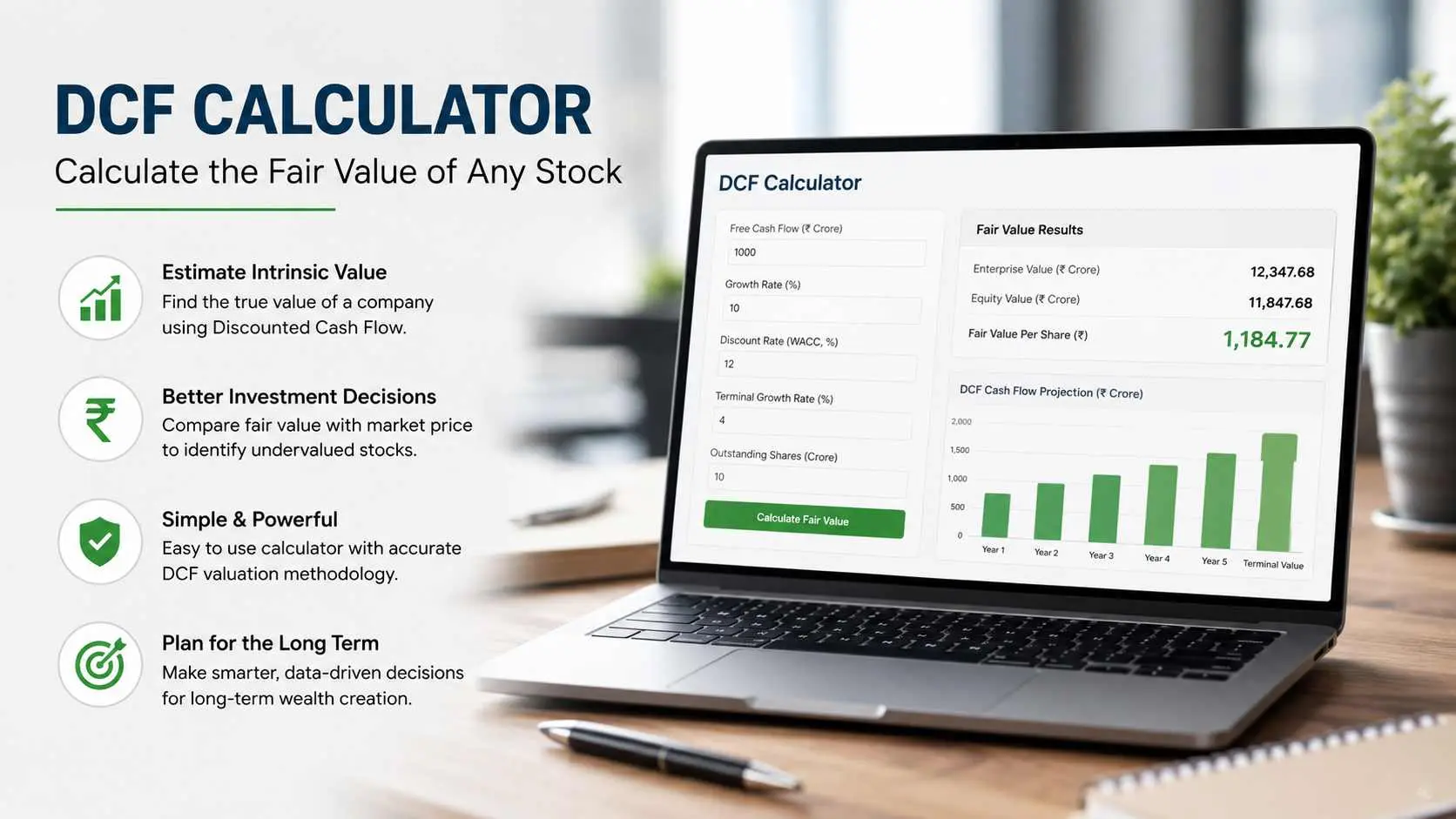
DCF Fair Value Calculator
A DCF Calculator (Discounted Cash Flow Calculator) is a valuation tool used to estimate the intrinsic or fair value of a company based on the present value of its expected future cash flows.
Unlike valuation methods that primarily compare a company’s price-to-earnings ratio or other market multiples with competitors, DCF valuation focuses on the cash a business is expected to generate in the future.
Our DCF Fair Value Calculator helps investors estimate the potential fair value of a stock using important assumptions such as free cash flow, growth rate, discount rate (WACC), terminal growth rate, and outstanding shares.
Note: DCF valuation is an estimate, not a guaranteed prediction of a stock’s future price. The result can change significantly when assumptions such as growth, WACC, or terminal growth are changed.
What Is a DCF Calculator?
A DCF Calculator estimates the present value of a company’s future free cash flows.
The basic principle behind discounted cash flow valuation is simple:
Money expected to be received in the future is worth less today because of the time value of money and the risk associated with future cash flows.
Therefore, a DCF model forecasts future cash flows and discounts them back to their present value using an appropriate discount rate.
In a typical FCFF-based DCF valuation, the calculated enterprise or firm value is then adjusted for debt and other relevant non-operating assets or liabilities to arrive at equity value. Dividing equity value by outstanding shares gives an estimated value per share.
How Does a DCF Calculator Work?
A DCF valuation generally follows these steps:
- Estimate the company’s future free cash flows.
- Determine an appropriate growth rate.
- Select an appropriate discount rate.
- Calculate the present value of future cash flows.
- Estimate the terminal value of the business.
- Discount the terminal value to its present value.
- Calculate the value of the business.
- Adjust for debt, cash, and other relevant items when required.
- Divide the resulting equity value by outstanding shares.
- Compare the estimated fair value with the current market price.
The fundamental idea can be represented as:
Business Value = Present Value of Expected Future Cash Flows + Present Value of Terminal Value
The exact implementation depends on whether the valuation uses Free Cash Flow to the Firm (FCFF) or Free Cash Flow to Equity (FCFE).
What Is Free Cash Flow?
Free cash flow is one of the most important inputs in a DCF model.
For an FCFF-based valuation, free cash flow represents the cash generated by the company’s operations after considering taxes and the reinvestment required to maintain and grow the business, before payments to debt and equity investors.
A commonly used FCFF framework is:
FCFF = EBIT × (1 − Tax Rate) − Capital Expenditure + Depreciation − Change in Working Capital
The exact calculation can vary depending on the company’s financial structure and the data being used.
A strong DCF analysis therefore requires more than simply looking at accounting profit. Investors should understand how much cash the business can actually generate and how much it needs to reinvest.
FCFF vs FCFE in DCF Valuation
There are two major approaches to discounted cash flow valuation.
1. Free Cash Flow to Firm (FCFF)
FCFF represents cash flows available to all providers of capital, including debt and equity investors.
When FCFF is used, the cash flows are discounted using WACC (Weighted Average Cost of Capital).
The resulting value represents the value of the operating business or firm. The analyst can then move from firm value to equity value by accounting for debt, cash and other relevant claims/assets.
2. Free Cash Flow to Equity (FCFE)
FCFE represents cash flow available specifically to equity shareholders after considering the effects of debt financing.
FCFE is discounted using the cost of equity rather than WACC.
Important DCF rule
The cash flow and discount rate must be consistent.
FCFF → WACC
FCFE → Cost of Equity
Mixing FCFF with the cost of equity, or FCFE with WACC, can produce an incorrect valuation.
DCF Calculator Inputs Explained
A DCF valuation depends heavily on its assumptions. Here are the major inputs used in a DCF Calculator.
1. Free Cash Flow
Free cash flow is the starting point for the valuation.
Historical free cash flow can be used as a base to estimate future cash flows. However, investors should examine whether recent cash flow is sustainable.
A temporary increase in working capital release, unusually low capital expenditure, or other one-time factors can make historical FCF misleading.
2. Growth Rate
The growth rate represents the expected rate at which free cash flow may increase during the forecast period.
For example, if current FCF is ₹100 crore and expected growth is 10%, next year’s projected FCF would be:
₹100 crore × 1.10 = ₹110 crore
Growth assumptions should ideally be supported by factors such as:
- Revenue growth
- Operating margins
- Return on capital
- Reinvestment requirements
- Competitive advantages
- Industry growth
- Company’s historical performance
A higher growth assumption generally increases estimated fair value.
3. Discount Rate / WACC
The discount rate reflects the required return for the risk associated with the expected cash flows.
When valuing a company using FCFF, WACC is commonly used as the discount rate.
A simplified WACC framework is:
WACC = (E/V × Cost of Equity) + (D/V × After-Tax Cost of Debt)
where:
- E = Market value of equity
- D = Market value of debt
- V = Equity + Debt
The appropriate discount rate depends on the company’s risk, capital structure, market conditions and other factors.
Why does WACC matter?
Suppose two companies generate exactly the same future cash flows.
If one company is considered significantly riskier, investors may demand a higher return. That higher discount rate reduces the present value of its future cash flows.
Therefore:
Higher WACC → Lower DCF value
Lower WACC → Higher DCF value
4. Terminal Growth Rate
It is generally impossible to forecast a company’s free cash flow year by year forever.
Therefore, DCF models usually forecast an explicit period and then estimate the value of all remaining future cash flows through a terminal value.
One common approach is the perpetual growth method:
Terminal Value = FCFₙ₊₁ / (WACC − g)
where:
- FCFₙ₊₁ = Free cash flow in the year after the forecast period
- WACC = Discount rate
- g = Long-term growth rate
Since the terminal value represents cash flows extending far into the future, the terminal growth assumption can have a substantial impact on the final valuation.
The terminal growth rate should therefore be realistic and consistent with the expected long-term economics of the business.
5. Outstanding Shares
After estimating the value attributable to shareholders, the total equity value can be divided by the number of outstanding shares to estimate the fair value per share.
Fair Value Per Share = Equity Value ÷ Outstanding Shares
CFA Institute describes the same basic relationship for DCF-based equity valuation.
DCF Fair Value Calculation: Step-by-Step
Consider a simplified example.
Suppose a company has:
- Current FCF = ₹100 crore
- Expected growth rate = 10%
- WACC = 12%
- Terminal growth rate = 4%
- Outstanding shares = 10 crore
The DCF model would project future free cash flows based on the growth assumption.
For example:
Year 1 FCF = ₹100 × 1.10 = ₹110 crore
Future cash flows would then be discounted back to their present value using the 12% discount rate.
After the explicit forecast period, terminal value would be calculated using the terminal growth assumption.
The present value of the projected cash flows plus the present value of the terminal value gives the estimated firm value under an FCFF framework.
After making appropriate adjustments for debt, cash and other relevant items, the resulting equity value can be divided by 10 crore outstanding shares to estimate the DCF fair value per share.
The actual result depends on the forecast period and the assumptions used in the model.
How to Interpret DCF Fair Value
Once you calculate the estimated fair value per share, you can compare it with the stock’s current market price.
If:
Market Price < Estimated Fair Value
The stock may appear undervalued based on the assumptions used.
If:
Market Price > Estimated Fair Value
The stock may appear overvalued based on the assumptions used.
However, this comparison should never be treated as a guaranteed buy or sell signal.
A stock can trade below its estimated DCF value because the market expects weaker future growth, higher risk, lower margins, greater capital requirements, or other factors that are not fully reflected in the model.
What Is Margin of Safety in DCF Valuation?
A margin of safety provides a buffer between the estimated intrinsic value and the price an investor is willing to pay.
For example, if a DCF model estimates fair value at ₹500 per share, an investor may choose to buy only if the market price is sufficiently below that estimate.
One simple way to calculate the implied upside is:
Upside = (Fair Value − Current Price) ÷ Current Price × 100
However, margin of safety is not simply the same thing as upside potential. A valuation estimate itself can be wrong, so the quality of the underlying assumptions matters greatly.
Why Is DCF Valuation Sensitive to Assumptions?
DCF valuation is powerful, but it is also highly sensitive to assumptions.
Small changes in:
- Growth rate
- WACC
- Terminal growth
- Operating margins
- Capital expenditure
- Working capital
- Free cash flow
can produce significantly different fair-value estimates.
For example, increasing the expected growth rate while reducing WACC can substantially increase the estimated value.
This is why a DCF model should be viewed as a valuation framework rather than a precise prediction of a stock’s future price.
DCF Sensitivity Analysis
A useful extension of a DCF model is sensitivity analysis.
Instead of calculating fair value using only one set of assumptions, you can calculate a range of possible values.
For example:
| WACC | Terminal Growth | Estimated Fair Value |
|---|---|---|
| 10% | 3% | Higher |
| 11% | 3% | Higher |
| 12% | 3% | Moderate |
| 12% | 4% | Higher |
| 13% | 4% | Lower |
A more advanced DCF Calculator can generate a complete sensitivity table showing how fair value changes when WACC and terminal growth assumptions change.
This can provide a much better understanding of valuation risk than relying on a single number.
DCF Valuation Methods
DCF models can be designed in different ways depending on the company’s growth characteristics.
Single-Stage DCF
A single-stage model assumes a relatively stable growth rate.
It is more suitable for mature businesses with relatively predictable cash flows.
Two-Stage DCF
A two-stage model assumes:
- A higher-growth period
- A stable-growth period
This can be useful for companies expected to grow faster initially before moving toward a more sustainable long-term growth rate.
Three-Stage DCF
A three-stage model can include:
- High-growth phase
- Transition phase
- Stable-growth phase
This provides greater flexibility for businesses whose growth is expected to change gradually over time.
These different DCF structures are commonly used in fundamental valuation analysis.
DCF Calculator vs Intrinsic Value Calculator
The terms fair value, intrinsic value, and DCF valuation are closely related but should not be treated as identical concepts.
DCF is one important method for estimating intrinsic value.
Other valuation approaches include:
- Dividend Discount Model
- Price-to-Earnings valuation
- Price-to-Book valuation
- EV/EBITDA valuation
- Comparable company analysis
- Asset-based valuation
Therefore, a stock’s intrinsic value can differ depending on the valuation methodology and assumptions used.
A DCF Calculator specifically estimates value through discounted future cash flows.
Advantages of DCF Valuation
DCF has several important advantages.
1. Focuses on Cash Flow
DCF focuses on the economic cash-generating ability of a business.
2. Forward-Looking
It incorporates expectations about future growth and profitability.
3. Flexible
The model can be adapted to different growth scenarios and business structures.
4. Useful for Fundamental Analysis
DCF can help investors think about what a business may be worth independently of its current market price.
5. Helps Identify Valuation Drivers
The model makes it easier to understand how growth, risk, margins and reinvestment affect valuation.
Limitations of DCF Valuation
DCF is not perfect.
Its biggest limitation is that the output depends on the assumptions entered into the model.
Important limitations include:
Forecasting Risk
Future cash flows are uncertain and difficult to predict.
Growth Assumption Risk
An overly optimistic growth rate can produce an unrealistic valuation.
Discount Rate Risk
A small change in WACC can materially change the result.
Terminal Value Risk
Terminal value can represent a large portion of total DCF value, making the valuation sensitive to terminal assumptions.
Business Complexity
Companies with highly cyclical earnings, unpredictable cash flows, rapidly changing capital structures, or significant financial uncertainty can be difficult to value using a simple DCF model.
Model Risk
Even mathematically correct calculations can produce poor valuations if the underlying assumptions are inappropriate.
When Should You Use a DCF Calculator?
A DCF Calculator can be particularly useful when analyzing companies with:
- Relatively predictable cash flows
- Established business models
- Understandable economics
- Reasonably estimable growth
- Sustainable competitive advantages
- Sufficient financial history
For highly speculative businesses, early-stage companies, or companies with extremely unpredictable cash flows, DCF results may be much less reliable.
DCF Calculator: Best Practices
Before relying on a DCF fair value estimate, consider the following:
- Use realistic growth assumptions.
- Review historical free cash flow.
- Understand the company’s capital expenditure requirements.
- Consider working capital requirements.
- Use a defensible discount rate.
- Keep terminal growth conservative.
- Check debt and cash balances.
- Consider dilution and outstanding shares.
- Perform sensitivity analysis.
- Compare DCF results with other valuation methods.
- Reassess the valuation when business fundamentals change.
Most importantly, avoid changing assumptions simply to make the calculated fair value match your desired stock price.
The purpose of DCF analysis is to test an investment thesis, not to justify one.
Frequently Asked Questions About DCF Calculator
What is a DCF Calculator?
A DCF Calculator estimates the present value of a company’s expected future cash flows and uses that valuation to estimate the fair or intrinsic value of the business or stock.
Is DCF the same as fair value?
Not exactly. DCF is a valuation method that can be used to estimate fair or intrinsic value. Fair value can also be estimated using other approaches.
What is the difference between DCF and intrinsic value?
Intrinsic value is the estimated economic value of an asset based on its fundamentals. DCF is one method used to estimate that value by discounting expected future cash flows.
What discount rate should I use in a DCF?
For an FCFF valuation, WACC is generally used. For an FCFE valuation, the cost of equity is generally used. The appropriate rate depends on the risk and financing characteristics of the company.
What is terminal growth in DCF?
Terminal growth is the assumed long-term growth rate used to estimate the value of cash flows beyond the explicit forecast period.
Can DCF be used for any stock?
A DCF model can theoretically be applied to many companies, but it is more useful when future cash flows can be estimated with reasonable confidence.
Is DCF valuation accurate?
DCF does not produce a guaranteed or exact value. It produces an estimate based on assumptions about future cash flows, growth, discount rates and other factors.
What happens if WACC is higher than terminal growth?
That condition is necessary for the standard perpetual-growth terminal value formula to produce a meaningful positive result. A terminal growth rate equal to or above WACC makes the conventional formula unsuitable.
Final Thoughts
A DCF Calculator can be a powerful tool for investors who want to estimate the fair value of a stock based on its expected future cash-generating ability.
The basic process is:
Estimate Future Cash Flows → Discount Them to Present Value → Calculate Terminal Value → Determine Business/Equity Value → Calculate Fair Value Per Share
However, the most important part of DCF valuation is not the calculator itself—it is the quality and realism of the assumptions.
A DCF model can produce a very precise-looking number while still being wrong if the growth rate, free cash flow, WACC, terminal growth rate, debt, or other assumptions are unrealistic.
Therefore, investors should use DCF valuation together with financial statement analysis, business analysis, industry research, management assessment, and other valuation methods rather than treating the DCF result as a standalone buy or sell signal.
Our DCF Calculator is designed to make this valuation process easier. As the calculator evolves, additional features can be incorporated to provide more detailed DCF analysis, scenario evaluation, and stock valuation insights.