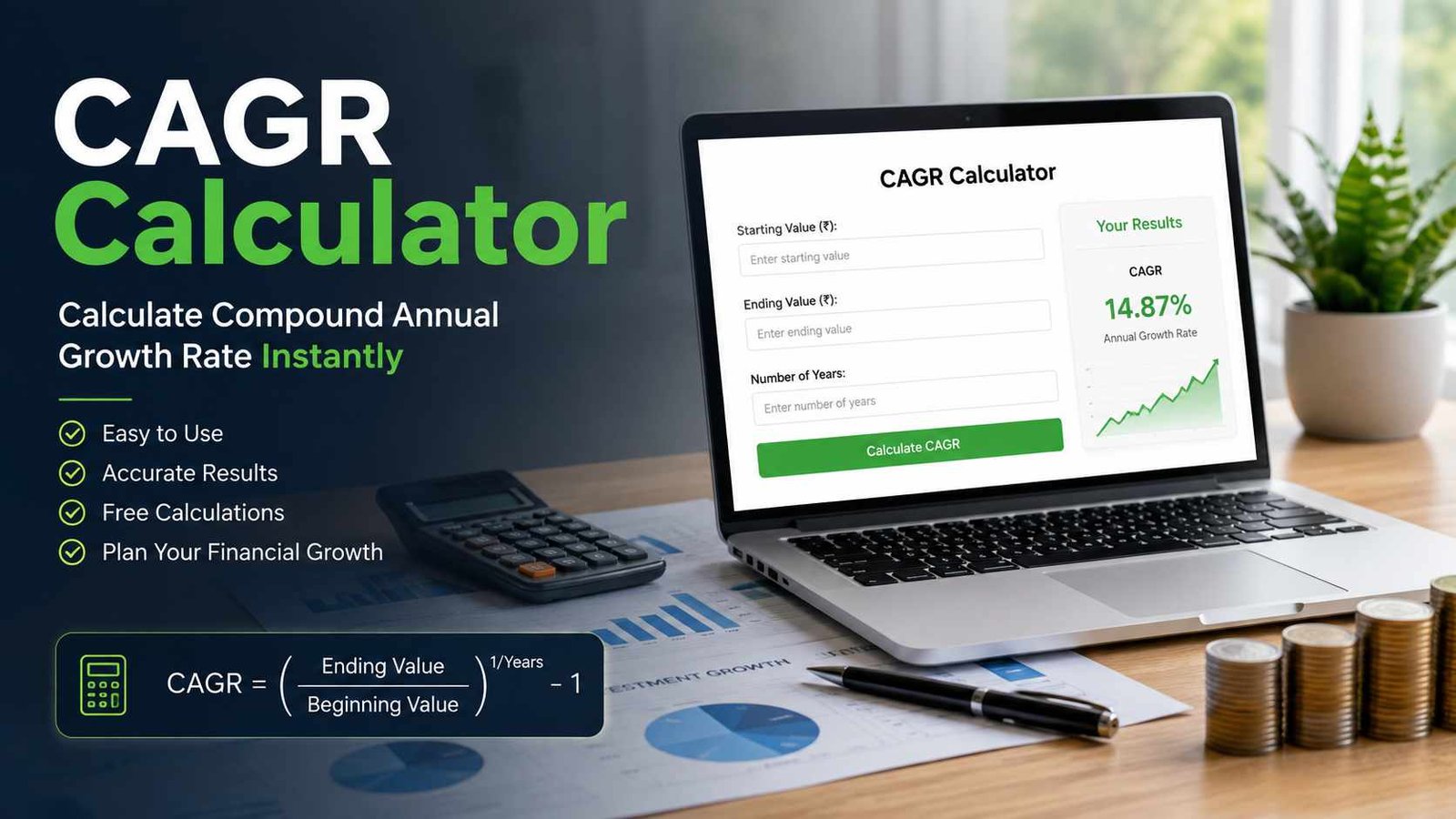
CAGR Calculator
Understanding how your investments grow over time is essential for making informed financial decisions. Our CAGR Calculator helps you quickly calculate the Compound Annual Growth Rate (CAGR) of an investment and evaluate its performance over a specific period.
Whether you invest in stocks, mutual funds, ETFs, business ventures, or fixed assets, CAGR provides a clear picture of the average annual growth rate of your investment.
Use the calculator above to instantly determine your investment returns and gain valuable insights into long-term wealth creation.
What Is CAGR?
CAGR (Compound Annual Growth Rate) is a financial metric used to measure the average annual growth rate of an investment over a specified period, assuming the profits are reinvested every year.
Unlike simple return calculations, CAGR smooths out fluctuations and provides a standardized growth rate that makes it easier to compare different investments.
For example, if an investment grows from ₹1,00,000 to ₹2,00,000 over 5 years, CAGR tells you the average yearly growth rate required to achieve that result.
Why Is CAGR Important?
CAGR helps investors:
- Measure investment performance accurately
- Compare multiple investment opportunities
- Evaluate mutual fund and stock returns
- Analyze business revenue growth
- Estimate long-term wealth creation
CAGR Formula
The CAGR formula is:
CAGR = (Ending Value / Beginning Value)^(1 / Number of Years) – 1
Where:
- Beginning Value = Initial investment amount
- Ending Value = Final investment value
- Number of Years = Investment duration
The result is usually expressed as a percentage.
How to Use the CAGR Calculator
Using our CAGR Calculator is simple:
Step 1: Enter the Starting Value
Input the initial amount you invested.
Step 2: Enter the Ending Value
Enter the current or final value of your investment.
Step 3: Enter the Number of Years
Provide the total investment period in years.
Step 4: Click "Calculate CAGR"
The calculator instantly displays the annualized growth rate of your investment.
CAGR Calculation Example
Let's understand CAGR with a practical example.
| Particulars | Value |
|---|---|
| Initial Investment | ₹1,00,000 |
| Final Value | ₹2,00,000 |
| Investment Period | 5 Years |
Applying the CAGR formula:
CAGR = (2,00,000 ÷ 1,00,000)^(1/5) − 1
CAGR = 14.87%
This means your investment grew at an average annual rate of approximately 14.87% per year over five years.
Benefits of Using CAGR
1. Easy Investment Comparison
CAGR allows investors to compare different investments using a single standardized metric.
2. Removes Volatility
Markets often fluctuate significantly. CAGR smooths these fluctuations and provides a consistent annual growth rate.
3. Measures Long-Term Performance
It is particularly useful for evaluating investments held for several years.
4. Helps in Goal Planning
Investors can estimate whether their current returns are sufficient to achieve future financial goals.
5. Useful for Businesses
Companies use CAGR to analyze growth in revenue, profits, customer acquisition, and market share.
Limitations of CAGR
Although CAGR is a valuable metric, it has some limitations.
Ignores Market Volatility
CAGR assumes smooth growth and does not reflect actual yearly fluctuations.
Not Suitable for Multiple Cash Flows
For SIP investments or investments involving regular contributions, CAGR may not provide accurate results.
Does Not Consider Risk
Two investments may have the same CAGR but significantly different risk levels.
CAGR vs Absolute Return
Many investors confuse CAGR with absolute return.
| Feature | CAGR | Absolute Return |
|---|---|---|
| Considers Time Period | Yes | No |
| Annualized Return | Yes | No |
| Suitable for Long-Term Investments | Yes | Limited |
| Comparison Between Investments | Better | Less Effective |
Example
If an investment grows from ₹1,00,000 to ₹1,50,000 in 5 years:
- Absolute Return = 50%
- CAGR = 8.45%
CAGR provides a more realistic measure of annual growth.
CAGR vs XIRR
Both CAGR and XIRR are used to evaluate investment performance, but they serve different purposes.
| Feature | CAGR | XIRR |
|---|---|---|
| Single Investment | Yes | Yes |
| Multiple Cash Flows | No | Yes |
| SIP Investments | No | Yes |
| Simplicity | Easy | Moderate |
When to Use CAGR?
Use CAGR when:
- You invest a lump sum amount.
- There is only one investment and one redemption.
When to Use XIRR?
Use XIRR when:
- You invest through SIPs.
- There are multiple investments and withdrawals.
CAGR for Stock Market Investments
CAGR is widely used in stock market analysis.
Investors often use CAGR to:
- Compare stock performance
- Analyze portfolio growth
- Evaluate long-term investment strategies
- Measure wealth creation potential
For example, if a stock delivered a CAGR of 18% over 10 years, it means the investment generated an average annual growth rate of 18%.
CAGR for Mutual Funds
Mutual fund investors frequently use CAGR to evaluate fund performance over long periods.
CAGR helps:
- Compare mutual funds objectively
- Analyze fund consistency
- Measure annualized returns
However, for SIP investments, XIRR is generally more appropriate.
CAGR for Business Growth Analysis
Businesses use CAGR to evaluate:
- Revenue growth
- Profit growth
- Customer growth
- Market expansion
- Product sales performance
A company with a 20% revenue CAGR over 10 years demonstrates strong and consistent growth.
How to Interpret CAGR Results
Less than 5%
Generally indicates slow growth.
5% to 10%
Represents moderate growth and may be suitable for conservative investments.
10% to 15%
Considered strong growth for many investment categories.
Above 15%
Typically reflects excellent long-term performance, though risk levels should also be evaluated.
Tips for Using CAGR Effectively
- Compare CAGR across similar investments.
- Consider risk along with returns.
- Use longer time periods for meaningful analysis.
- Do not rely solely on CAGR when evaluating investments.
- Combine CAGR with other financial metrics for better decision-making.
Frequently Asked Questions (FAQs)
What does CAGR stand for?
CAGR stands for Compound Annual Growth Rate.
Is CAGR better than absolute return?
For long-term investments, CAGR generally provides a more accurate performance measure because it accounts for time.
Can CAGR be negative?
Yes. If the final value of an investment is lower than the initial value, CAGR will be negative.
Is CAGR useful for mutual funds?
Yes, especially for lump-sum mutual fund investments.
Can CAGR be used for SIP investments?
No. For SIP investments, XIRR is usually a more accurate metric.
What is a good CAGR for stocks?
A CAGR above 12%–15% over a long period is generally considered strong, though it varies by market conditions.
Does CAGR include dividends?
Only if dividends are reinvested and included in the final investment value.
Why is CAGR important?
CAGR helps investors understand the annualized growth rate of their investments and compare different opportunities effectively.
Conclusion
The CAGR Calculator is a powerful tool for measuring investment performance and understanding long-term growth. By calculating the Compound Annual Growth Rate, investors can evaluate stocks, mutual funds, businesses, and other assets using a consistent annual growth metric.
Use the calculator above to determine your investment growth rate instantly and make more informed financial decisions based on reliable performance analysis.